
Most SEO goes wrong in the same way. An agency delivers a document, somebody at your end is supposed to action it, and six months later half of it is still unactioned and nobody can say what the other half achieved.
We implement. On client sites we work directly in the CMS, so fixes go live rather than sitting in a spreadsheet waiting for a developer who has other priorities.
And we are measured against enquiries rather than rankings. A ranking is evidence that something might eventually become a result. It is not the result.
Why most content never compounds
Most sites are a flat pile of pages. A services menu, a blog in date order, nothing connecting any of it. Each page competes alone, which is why a business can publish for two years and move nothing.
We build hub and spoke. One authoritative page owns each topic. Supporting pages underneath answer the specific questions buyers ask. Every spoke links up to the hub, the hub links down to every spoke, and the hub inherits the authority of everything beneath it.
Eight connected pages will outperform forty unconnected ones. The structure is the work, not the volume.
What we do
Technical SEO
Crawl and indexation, site speed and Core Web Vitals, mobile, HTTPS, redirects, and the functional pages sitting in Google that nobody would choose to show a customer. We verify in the source rather than asserting from a crawl.
Search demand research
What your buyers actually type, including the dietary, occasion and problem-led terms that carry volume and never appear in a keyword tool export you were handed by somebody else.
Content architecture
Your hubs and spokes mapped before anything is written, so each new page has a home and a job rather than being added to a pile.
On-page and internal linking
Titles, headings, copy and the internal links that move authority toward the pages that sell. Internal linking is the cheapest ranking work available and it is almost always missing, because it is nobody's job.
Schema and structured data
Organisation, Product, Service, FAQ and Local markup, verified in the source. Most sites believe a plugin handles this. Frequently the plugin is outputting nothing, or two conflicting versions of the same thing.
Content production
Briefs and finished content written to rank and to read, published and linked rather than handed over.
Measurement
Against the one number agreed at the start. We check platform-reported conversions against what actually reached your inbox, because if those two disagree nothing else can be trusted.
What we find most often
Six issues turn up again and again. Tracking that counts the wrong thing. No hub and spoke structure. Your own pages competing for the same term. Content nothing would quote. Internal linking close to zero. Schema assumed to be there and not there.
Most of these were present on sites actively paying for SEO at the time.
We are specialists, not generalists with a template
SEO advice that ignores your sector is worth roughly what you paid for it. A supplement brand and a tour operator have almost nothing in common in how their customers search, what regulators allow them to say, or which schema types earn them visibility.
We work with brands built on experiences and consumables, which means we already know the search behaviour, the seasonality and the compliance traps in these markets:
- SEO for travel and tourism brands - long consideration windows, brutal OTA competition, destination and itinerary search demand
- SEO for health and wellness brands - YMYL scrutiny, E-E-A-T requirements, and content that has to be both compliant and persuasive
- SEO for supplement brands - the ASA CAP Code, authorised health claims, and how to rank without writing anything you would have to withdraw
- SEO for food and beverage brands - recipe and product search, retailer competition, and local demand for venues and stockists
The Visibility Audit
Free. Send your website address and, if you have them, read access to Google Analytics and Search Console.
Back within five working days, one page:
- Where you rank for the terms that matter commercially
- Whether your own pages are competing against each other
- What your structure is costing you
- Whether tracking can be trusted
- The order to fix things in
Every finding labelled as verified live, reasoned inference, or requires connected data. No deck and no pitch.
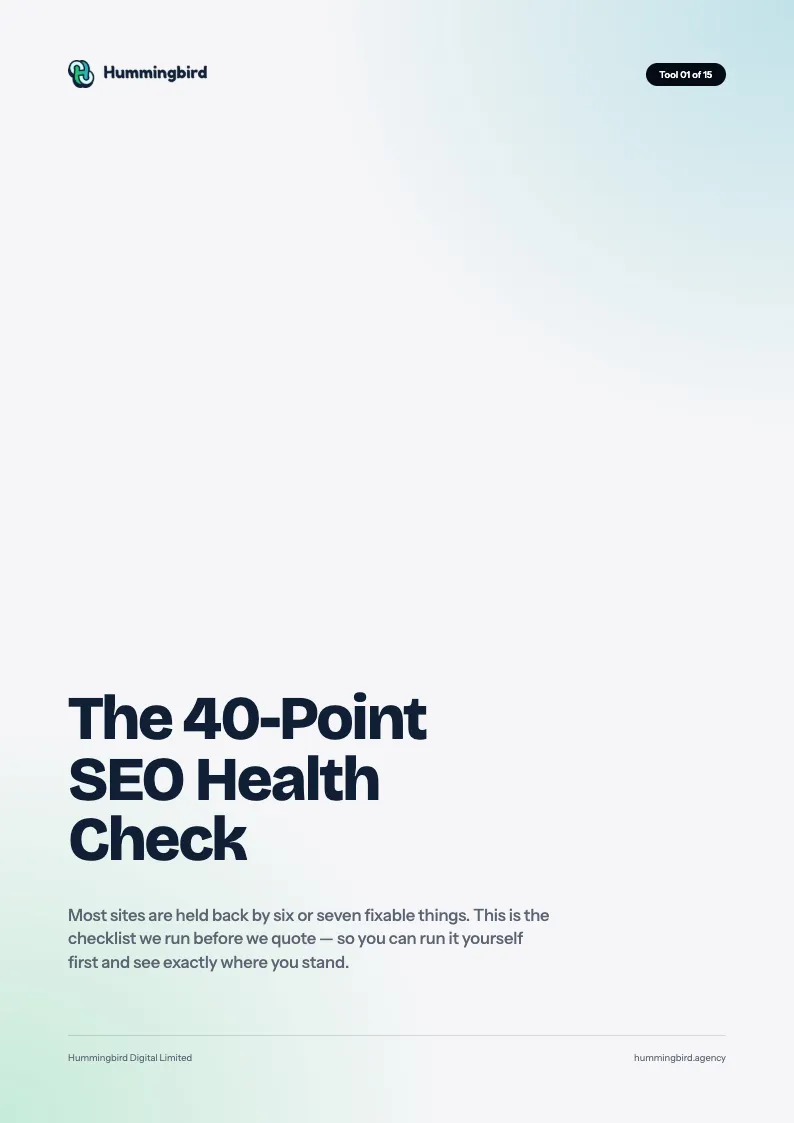
The 40-Point SEO Health Check
A free 8-page checklist. Most sites are held back by six or seven fixable things. This is the checklist we run before we quote, so you can run it yourself first and see exactly where you stand.
- 40 checks across crawlability, indexation, on-page, content, speed and authority
- The five issues that silently strangle the most sites, and how to spot them in ten minutes
- A simple pass, fix or ignore rating for every item so you are not left with a to-do list of 40 equal priorities
- The three things to check before you pay any agency a penny
Frequently asked questions
How long before SEO works?
Six months before you judge it, nine before you scale it. Anything faster is a guess. If someone promises results in eight weeks, ask what they are going to change that fast.
Do you implement or just advise?
Implement. We work directly in the CMS on client sites. Recommendations somebody else has to action are the main reason SEO retainers fail.
Will a new website hurt my rankings?
It can, and that is the most common reason a redesign loses money. We map every URL before anything changes and redirect each one.
Do we need SEO if we are already running ads?
They do different jobs. Ads stop the moment you stop paying. SEO lowers the long term cost of the same traffic. Most businesses should run both in a deliberate split rather than whichever one they started with.
Can you work alongside our existing agency?
Yes, and if the audit finds they are doing good work we will tell you that.
Related services and reading
Get in touch
Find us here
Allia Future Business Centre
Peterborough, PE2 8AN
Call or email
Opening hours
Monday - Friday
9:00 - 17:00