
People do not search for your product. They search for dinner, for a dairy-free birthday cake, for somewhere to eat on Saturday. We make your brand the answer to the question they actually asked.
What does SEO for food and drink brands involve?
Food and beverage SEO means capturing demand that is usually expressed as a need rather than a product: recipes, occasions, dietary requirements and local intent. It combines recipe and product structured data, category and PDP optimisation, local SEO for venues and stockists, and content built around how people actually search for food.

Almost nobody searches for the product. They search for the occasion.
This is the thing that trips up nearly every food and drink brand doing SEO. You have built pages for your products, optimised them for your product names, and you are competing for a few hundred searches a month against Tesco, Ocado and Amazon. Meanwhile the actual demand, tens of thousands of searches, is sitting in queries like what to cook with leftover chicken, dairy free birthday cake recipe, best gin for a negroni, and gluten free brownies delivered.
Food search is need-led, occasion-led and dietary-led. The product is the answer, not the query. Brands that understand this build content around the need and let the product sit at the end of it, which is why a producer with good recipe content can out-traffic a much bigger competitor with a better-looking shop.
Then there is the structured data advantage, which is unusually large in this category. Recipe markup earns you rich results and eligibility for surfaces most sectors do not have access to. Product, Offer, Review, Menu and LocalBusiness schema all pull real weight here. A surprising number of food brands have none of it implemented correctly, which is a free win sitting in plain sight.
In food and drink, the fastest route to visibility is usually structural, not creative. Fix the schema, build for the need rather than the SKU, and get the local signals right if you have venues or stockists. The brand work matters, but it matters more once people can find you.
The food and drink search problems we see most
Optimising for products nobody searches
Pages built around SKU names with negligible demand while the occasion and recipe queries that drive the category go unclaimed. We rebuild the strategy around need-led search.
Missing or broken recipe schema
Recipes published as plain articles, invisible to the rich results and food surfaces they should qualify for. We implement and validate Recipe markup properly, including nutrition, yield, timing and video.
Supermarkets owning your category
Retailers and marketplaces ranking above you for your own category terms. We defend brand search, own the specialist and dietary long tail, and make your product pages the definitive source on your own range.
Dietary and allergen queries unanswered
No visibility on gluten free, dairy free, vegan, low sugar and allergen searches, which are among the highest-intent and fastest-growing queries in food. Answering them precisely also builds real trust.
Local search neglected
Venues, farm shops, taprooms and stockists with unoptimised Google Business Profiles, inconsistent listings and no location pages worth indexing. Near me demand is enormous and cheap to win.
Seasonal demand missed every year
Christmas, Easter, barbecue season and Veganuary content published as the peak arrives rather than before it. We plan production against demand curves, then refresh rather than rebuild annually.
What we do for food and drink brands
Need-Led keyword strategy
Query mapping across recipes, occasions, dietary needs, pairings, substitutions and local intent, with each cluster assigned to the right page type and commercial outcome.
Recipe and food structured data
Recipe, Product, Offer, Review, Menu, LocalBusiness and FAQ schema implemented and validated. The highest-leverage technical work available in this sector.
Recipe and content production
Recipe hubs and occasion content built to rank, structured for rich results, and designed to lead naturally to your products rather than sitting in a content silo.
Product and category page SEO
PDPs and category pages rebuilt with ingredient detail, allergen information, provenance, tasting and usage content, plus variant handling that stops your own pages competing.
Local and multi-site SEO
For venues, shops, taprooms and stockist networks: Google Business Profile optimisation, distinct location pages, review strategy and stockist finder indexation.
Seasonal and occasion planning
A content calendar built backwards from demand peaks, with existing pages refreshed and re-promoted so equity compounds instead of resetting each year.
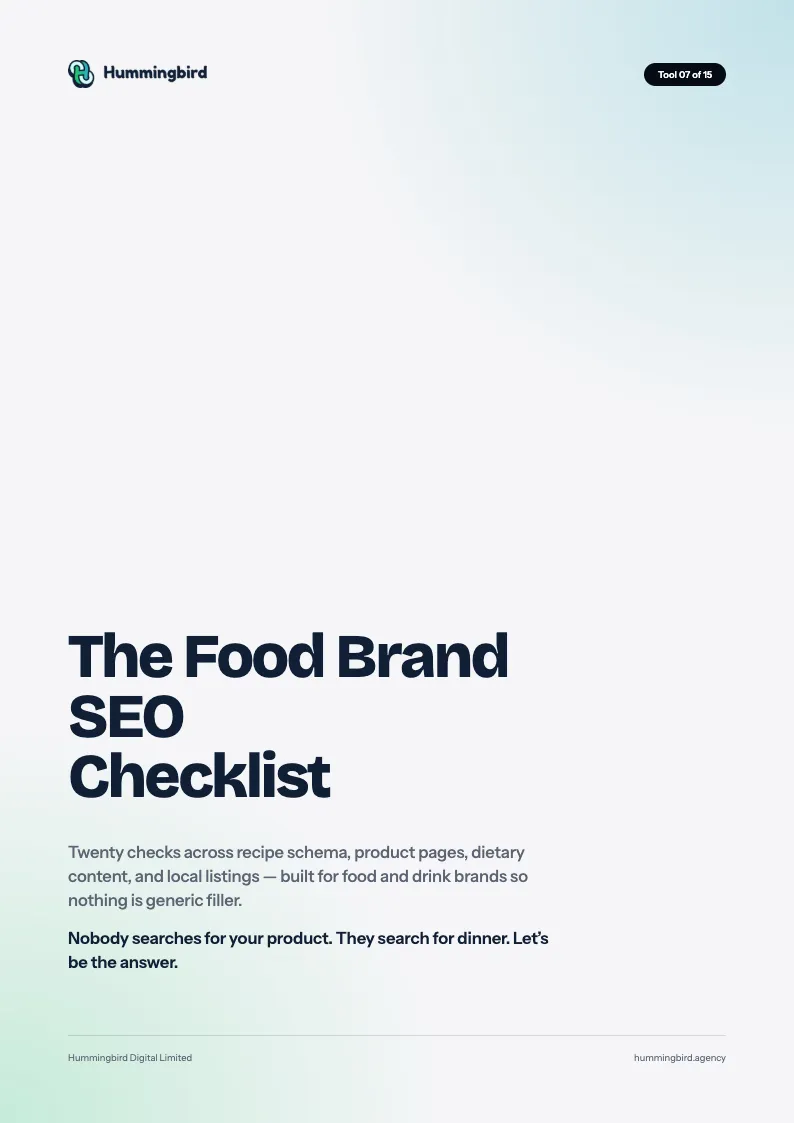
The Food Brand SEO Checklist
A free 6-page checklist. Twenty-four checks across recipe schema, product pages, dietary content and local listings. Built for food and drink brands, so nothing on it is generic filler.
- The complete Recipe schema field checklist, including the fields most brands leave out
- 7 product and category page checks specific to food and drink, including allergen and provenance content
- A local SEO checklist for venues, taprooms, farm shops and stockist finders
- The seasonal content calendar template we plan client years from
The five demand types in food and drink search
Most brands build for the last row and ignore the first four, which is where the volume lives. This is the map we build content strategies from.
| Demand type | Example searches | Page format that wins | Commercial job |
|---|---|---|---|
| Recipe and how-to | how to make sourdough, easy midweek curry, what to do with leftover ham | Recipe page with full schema, video and clear steps | Enormous top-of-funnel reach and email capture |
| Occasion and gifting | food hampers for Christmas, birthday cake delivery, barbecue ideas for a crowd | Curated occasion landing pages, refreshed annually | High basket value, strongly seasonal conversion |
| Dietary and allergen | gluten free brownies, dairy free ice cream, vegan cheese that melts | Precise, honest dietary category pages with clear labelling | Very high intent, loyal repeat buyers |
| Pairing and comparison | best gin for a negroni, which cheese for a board, X vs Y | Comparison and pairing guides with genuine opinion | Positions you as the expert and drives basket size |
| Product and local | your brand name, near me, where to buy X, stockists | Optimised PDPs, location and stockist pages | Converts existing demand and defends your margin |
How a food and drink SEO engagement runs
Demand audit
Weeks one to three. We map the real search demand in your category across all five demand types, technically audit the site, and show you what share of it you currently hold. It is usually a small share.
Fix the structure
Weeks two to six. Schema implemented and validated, product and category pages rebuilt, local listings corrected, variant and duplication issues resolved. Fast wins live here.
Build for the need
Month two onwards. Recipe, occasion and dietary content produced against the demand map, each cluster designed to lead to a product or a booking rather than a dead end.
Plan the year, compound it
Ongoing. Seasonal calendar executed ahead of demand, existing pages refreshed and re-promoted, and continuous expansion into the next demand cluster.
Food and drink brands we build search programmes for
Food, drink and hospitality run right through Hummingbird's client base, from artisan producers to hotel restaurants. Our hotels and restaurants and e-commerce work both feed into how we approach this sector, because most food brands are running a venue, a shop, or both.
- Artisan and specialist producers competing with supermarket own-label and marketplaces
- DTC food and drink brands with subscription or repeat-purchase models
- Bakeries, patisseries and cake businesses with heavy occasion and dietary search demand
- Drinks brands, breweries, distilleries and wineries with taprooms and stockist networks
- Restaurants, cafes and hospitality groups where local search is the whole game
- Free-from and dietary-specialist brands sitting on some of the highest-intent search in food

Food, drink and hospitality are home turf
Hummingbird works across food, drink and hospitality brands, from independent producers to hotel restaurants, and our client list includes names like Rachael's Kitchen and Bear's Brownies alongside our wider hotels and restaurants work. We understand the seasonality, the margins and the fact that a great product does not market itself.
Don't just take our word for it.
“Hummingbird have built our Social presence from the ground up. Led by Tom Anderson, the team have proven to be creative, supportive and consistently great value - everything we hope for in a key business partner. We highly recommend them.”
“Hummingbird are a great digital implementation agency. I’ve worked with them for a year & am highly impressed with their proficiency in managing our social media platforms. They are enthusiastic, knowledgeable, organised, creative and has developed great insight into our business, so much so that they feel like a part of our in-house team.”
“We used Hummingbird to increase awareness of our new weekend overnight stay package and the results were fantastic. We saw huge impressions and engagement and a wonderful click through rate. I would recommend and will use again.”
Let's find the demand you are not capturing
Tell us what you make and where you sell it. We will come back with the recipe, occasion and dietary searches in your category that nobody is properly answering.

Related services and reading
- AEO for Food & BeverageWin the recipe, substitution and allergen answers AI now handles directly.
- GEO for Food & BeverageBe the brand named when someone asks a model what to buy or where to eat.
- SEO ServicesThe core SEO offer: technical, content, authority and reporting.
- Hotels & RestaurantsOur hospitality marketing offer for venues, groups and restaurants.
- E-Commerce MarketingConversion, retention and lifetime value for online food and drink stores.
- Content MarketingFood photography, video and social content that makes search work harder.
Frequently asked questions
Is recipe content worth it if we sell products rather than publish recipes?
For most food and drink brands, yes, and it is often the single largest source of qualified organic traffic available to them. Recipe searches are enormous, they are how people actually look for food, and a recipe using your product puts you in front of someone at the exact moment they are deciding what to buy.
The mistake is publishing recipes that go nowhere. Every recipe should have a clear path to the relevant product, and the recipe hub should be part of your site architecture rather than a walled-off blog.
How do we compete with supermarkets in search?
Not on generic category terms, where retailer authority is overwhelming. You win on brand and product terms, on specialist and dietary long tail where retailer pages are thin, on recipe and occasion content they publish generically, and on provenance and craft detail a supermarket listing cannot carry.
You also often win locally, which retailers with no local presence in your area simply cannot contest.
What structured data should a food brand implement?
At minimum: Product and Offer on PDPs, Recipe on recipes with full nutrition, yield and timing fields, LocalBusiness or Restaurant on location pages, Menu where relevant, Review or AggregateRating where you hold genuine reviews, Organisation sitewide and FAQPage where there are real questions.
All of it validated against Google's Rich Results Test. Half-implemented schema is common in this sector and earns nothing.
How important is local SEO for a food brand?
Critical if you have any physical presence at all: a shop, a taproom, a cafe, a market stall, or stockists. Near me search volume in food and drink is huge and the competition is often weak, because most independents never optimise their Google Business Profile beyond the basics. It is usually the cheapest available win in this sector.
When should we publish seasonal content?
Earlier than feels natural. Christmas hamper and gifting content should be live and indexed by late summer. Veganuary content by late November. Barbecue and picnic content by early spring. New pages need runway to rank, and an existing page refreshed and re-promoted almost always outperforms a fresh one published at the last minute.
Can you help with allergen and dietary content?
Yes, and it needs care. Dietary and free-from queries carry exceptionally high intent, and accuracy is non-negotiable because people make health decisions on it. We write precise, clearly qualified dietary content, work to whatever your labelling and cross-contamination position actually is, and never overstate a claim to win a search term.
Does AI search matter for food and drink?
A great deal, because recipe, substitution and best-brand-for questions are almost perfectly suited to generative answers. Models happily name food products and venues, which makes this one of the more winnable categories. See our food and drink AEO and food and drink GEO pages.
We run both a venue and an online shop. Can one site do both?
Yes, and it usually should, because the authority is shared. It needs deliberate architecture though: local pages built for local intent, e-commerce built for product and dietary intent, and content that serves both without one cannibalising the other. Getting that structure wrong is one of the more common problems we untangle in this sector.
Get in touch
Find us here
Allia Future Business Centre
Peterborough, PE2 8AN
Call or email
Opening hours
Monday - Friday
9:00 - 17:00