
Can I use olive oil instead of butter. Is this gluten free. What goes with a Malbec. Food search is almost entirely questions, and something else is answering them now.

Why does AEO matter for food and drink brands?
Food search is dominated by questions: substitutions, conversions, cooking times, allergens, pairings and storage. Answer engines and voice assistants handle these directly, often while the user's hands are covered in flour. Being the cited source for those answers puts your brand in the kitchen at the exact moment a purchase decision is being formed.

Nobody clicks through a search result with butter on their hands
Food is the most naturally answer-shaped category in search. Can I substitute buttermilk. How long do I roast a 2kg chicken. Is Worcestershire sauce vegan. What temperature is 180 fan in a conventional oven. What cheese goes with quince. These are asked constantly, often out loud, often mid-task, and they demand a single clean answer rather than a page of options.
Which is why food has been quietly transformed by the answer layer faster than almost any other sector. Voice assistants were doing this before AI Overviews existed. Recipe rich results have been reformatting food search for a decade. Now generative answers handle substitutions and conversions instantly, and the click that used to land on a recipe blog frequently does not happen.
Here is the good news, and in food it is genuinely good. This category rewards structured data more than any other, and answer engines love a table. Conversion charts, substitution ratios, cooking time tables, allergen matrices, pairing grids: these are exactly the formats engines lift, and they are cheap to produce compared with the photography and video most food brands spend their budget on.
Better still, the competition is soft. The food content estate on the web is enormous and mostly unstructured: 1,800-word personal essays with the actual answer buried in paragraph nine, no Recipe schema, no substitution table, no clear yield or timing fields. A food brand that publishes the answer plainly, marks it up properly and keeps it accurate can get cited far above its weight.
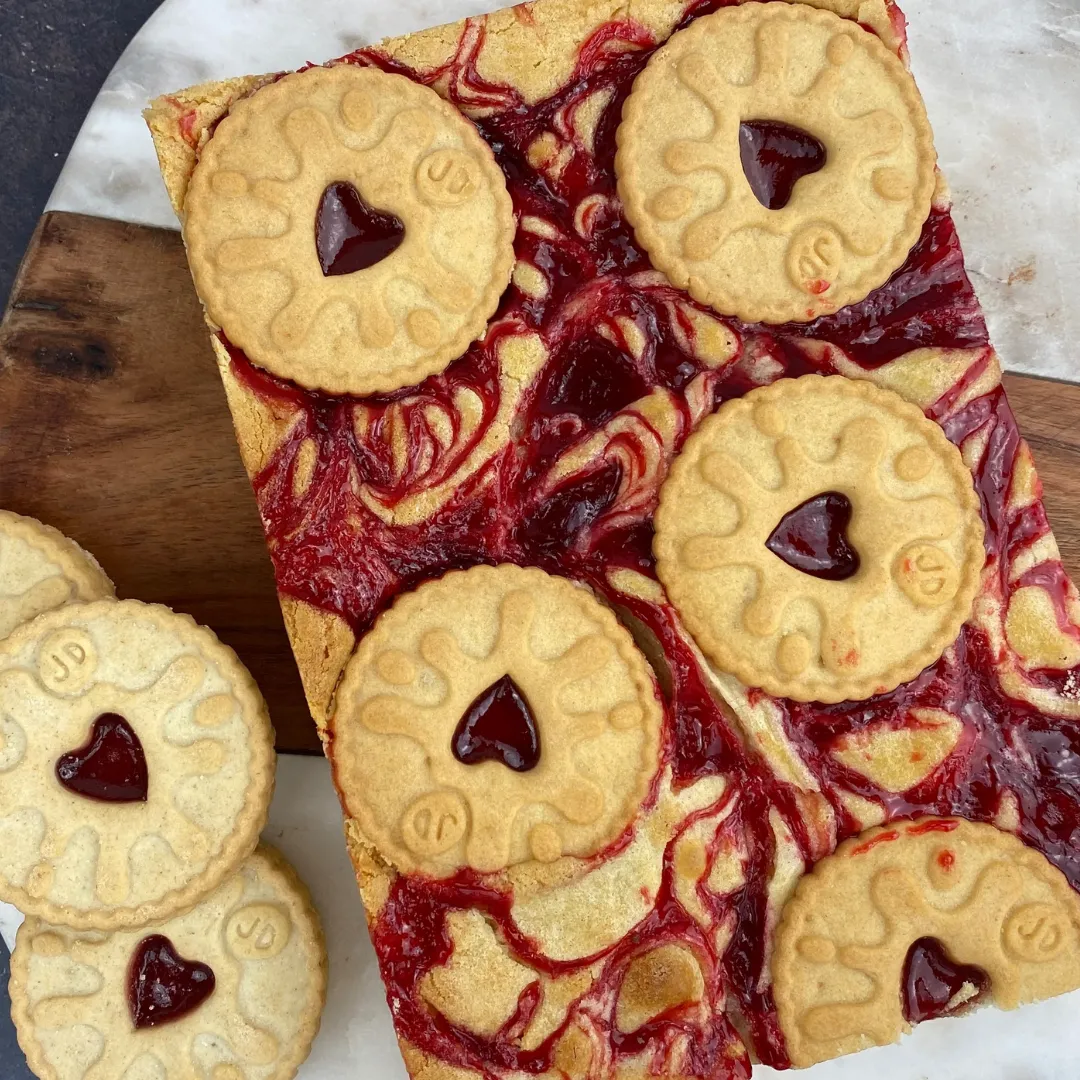
Six food question types the answer layer has absorbed
Each of these is high volume, high frequency and low competition in structured form. This is the map we build food AEO programmes from.
| Question type | Example | What wins the citation |
|---|---|---|
| Substitution | what can I use instead of buttermilk | A ratio-based substitution table with results described honestly, not a paragraph of prose |
| Conversion and timing | 180 fan in conventional, how long to roast a 2kg chicken | Clean conversion and timing tables with weights, temperatures and rest times |
| Allergen and dietary | is X vegan, does X contain gluten | Precise, unambiguous, clearly qualified statements with your labelling position stated |
| Pairing and matching | what wine with lamb, best cheese for a board | Confident specific recommendations with reasoning, ideally in a grid |
| Storage and safety | how long does opened X keep, can you freeze X | Direct answers with timeframes and conditions, dated and clearly sourced |
| Technique | how to stop pastry shrinking, why did my bread not rise | Cause and fix pairs, structured as a diagnostic list rather than a story |
What we do for food and drink brands in the answer layer
Food answer baseline
Your category's question set run through AI Overviews, Copilot, Perplexity, ChatGPT and voice assistants, with every citation logged so you can see who currently owns the answers you should.
Recipe schema done properly
Full Recipe markup including yield, prep and cook times, nutrition, ingredients, instructions and video, validated. Most food sites implement a fraction of the available fields.
Structured answer assets
Substitution tables, conversion charts, timing grids, allergen matrices and pairing guides. The highest citation-per-hour content available in this sector.
Answer-First recipe rewrites
The answer, the ratio or the timing up front, with the story and the photography underneath. Your voice stays, the burial does not.
Allergen and dietary precision
Careful, accurate, clearly qualified dietary content. High intent, high trust, and an area where being vague costs you both citations and credibility.
Local and voice answers
For venues: opening hours, menu, booking, dietary and accessibility questions structured for voice and local answers, with LocalBusiness and Menu schema in place.
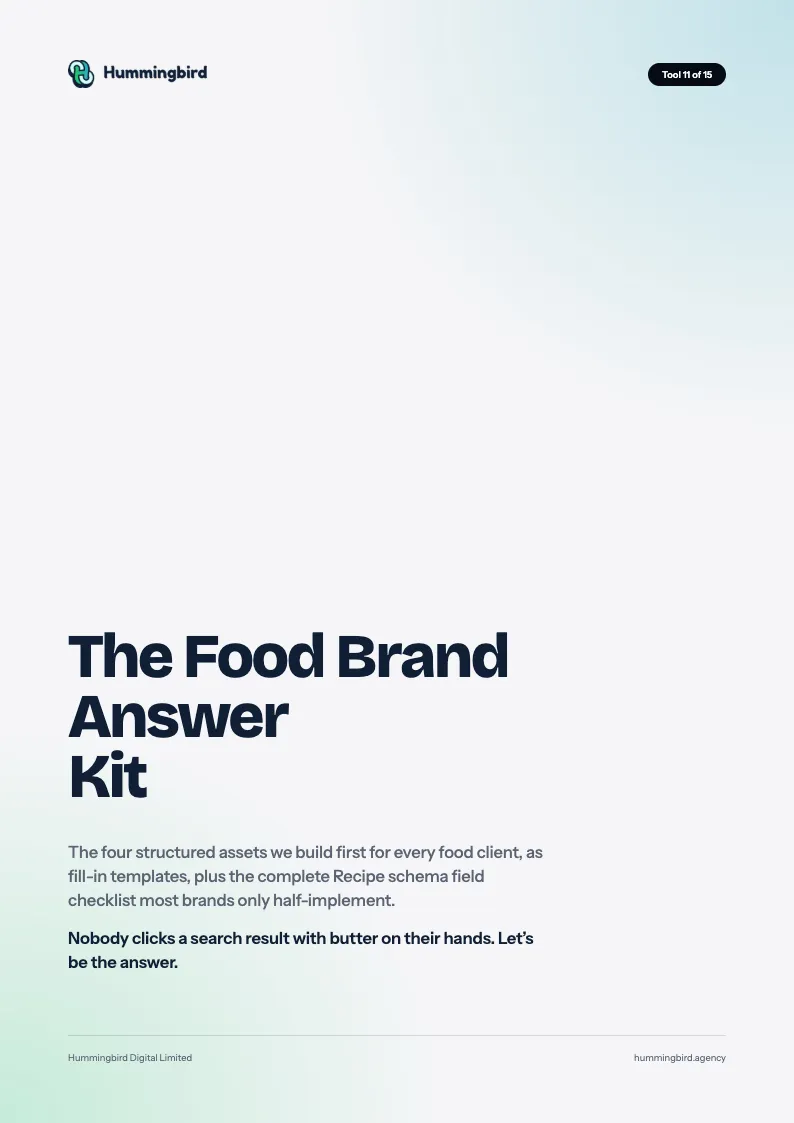
The Food Brand Answer Kit
A free 8-page template pack. The four structured assets we build first for every food client, as fill-in templates, plus the complete Recipe schema field checklist most brands only half implement.
- Substitution table template with the ratio and honest-result columns engines quote
- Conversion and timing chart templates for oven, air fryer and weight-based cooking
- An allergen and dietary answer template with safe, precise qualifying language
- The full Recipe schema field checklist, marked for which fields most brands miss
- 30 food and drink questions worth owning, grouped by type
How a food and drink AEO engagement runs
Baseline the questions
Weeks one to two. Your category's question set tested across engines and voice, with citations logged. Fast, because food questions are easy to enumerate and the gaps are obvious.
Fix the markup
Weeks two to four. Recipe, Product, LocalBusiness, Menu and FAQ schema implemented and validated. In food this is often the single highest-return technical job available.
Build the structured assets
Month two onwards. Substitution, conversion, timing, allergen and pairing assets produced and interlinked, plus answer-first rewrites of your strongest existing recipes.
Season and sustain
Ongoing. Citation tracking, seasonal question sets built ahead of peaks, and continuous accuracy maintenance on anything with a date, a temperature or a dietary claim on it.
Food and drink brands sitting on uncited expertise
Almost every food business we meet already knows the answers. The baker knows why pastry shrinks. The distiller knows what to mix it with. The chef knows how long to rest it. None of it is written down in a form a machine can quote, which makes it invisible.
This builds on our food and beverage SEO, hospitality and e-commerce work:
- Producers and specialist food brands with genuine technical craft knowledge
- DTC food and drink brands where usage and recipe questions drive repeat purchase
- Bakeries and patisseries facing constant technique, substitution and dietary questions
- Drinks brands, breweries and distilleries with pairing, serving and cocktail demand
- Free-from and dietary brands where allergen precision is both duty and advantage
- Restaurants and hospitality groups answering practical questions in voice and local search

Three rules we apply to every food page
Table it
If the answer contains numbers, ratios, temperatures or a list of options, it belongs in a table. Prose descriptions of numeric relationships are the most commonly wasted content in food publishing and almost never get cited.
Answer, then story
The substitution ratio in the first line. The anecdote about your grandmother afterwards. Both can exist on the same page, and the order is the entire difference between being quoted and being scrolled past.
Never be vague on allergens
Dietary answers must be precise and honest about the limits, including cross-contamination. Engines reward unambiguous statements, and here accuracy is not a marketing preference, it is a duty of care.
Food and hospitality clients, and a structural approach to content
Hummingbird works across food, drink and hospitality, from independent producers like Rachael's Kitchen and Bear's Brownies to hotel restaurants through our hotels and restaurants practice. We know the difference between content that looks appetising and content that gets found, and we would rather build both than choose.
Don't just take our word for it.
“Hummingbird have built our Social presence from the ground up. Led by Tom Anderson, the team have proven to be creative, supportive and consistently great value - everything we hope for in a key business partner. We highly recommend them.”
“Hummingbird are a great digital implementation agency. I’ve worked with them for a year & am highly impressed with their proficiency in managing our social media platforms. They are enthusiastic, knowledgeable, organised, creative and has developed great insight into our business, so much so that they feel like a part of our in-house team.”
“We used Hummingbird to increase awareness of our new weekend overnight stay package and the results were fantastic. We saw huge impressions and engagement and a wonderful click through rate. I would recommend and will use again.”
Find out who is answering your customers' food questions
Tell us what you make. We will run your category's questions through the answer engines and voice assistants, and show you which ones are sitting there unclaimed.

Related services and reading
- SEO for Food & BeverageRecipe, product and local search: the foundation the answer layer needs.
- GEO for Food & BeverageBe the brand named when someone asks a model what to buy or where to eat.
- AEO ServicesOur core answer engine optimisation offer across all sectors.
- Hotels & RestaurantsHospitality marketing for venues, groups and restaurants.
- E-Commerce MarketingConversion, retention and lifetime value for online food and drink stores.
- AEO Guide 2026How answer engines pick sources and what to change first.
Frequently asked questions
If AI answers the recipe question, do we lose the traffic?
You lose some low-value visits and gain presence at the moment of decision. A substitution answer that names your product, or a recipe citation that credits your brand, reaches someone standing in their kitchen about to buy something.
The honest strategy is to concede the tiny answers, the conversions and one-line substitutions, and to own the answers that lead somewhere: full recipes using your products, pairing guides, dietary category answers and technique content that builds real loyalty.
What is the single highest-return thing we can do?
Implement Recipe schema completely, on every recipe, with every relevant field populated and validated. In food and drink this is consistently the fastest and largest win available, and a striking number of brands have it partially implemented or broken.
After that, build a substitution or conversion table. Those two jobs typically take days and produce citations for years.
Does voice search still matter?
In food, more than in any other category, because cooking is hands-free by nature. Voice answers are single-answer surfaces, so there is no position two. Clean structured markup, direct answers and precise timings are what make a page eligible, and few food brands optimise for it deliberately.
How careful do we need to be with allergen answers?
Extremely, and this is one place where we will push back on marketing instincts. Allergen content must be precise, current and honest about cross-contamination risk, and it should reflect exactly what your labelling and production reality supports. Never simplify an allergen answer to make it more quotable. Accurate qualification is both safer and, as it happens, more citable.
We are a venue rather than a product brand. Does this apply?
Yes, and the question set is different. For venues the answer layer is dominated by practical questions: are you open on Sundays, do you have gluten free options, is there parking, do you take walk-ins, is it dog friendly. These are asked constantly and answered badly by most venues. LocalBusiness and Menu schema plus a well-structured FAQ often produces very quick wins.
How long before we see citations?
Food is one of the faster categories. Schema fixes can produce rich result and answer eligibility within two to six weeks. Structured assets like substitution and conversion tables often get picked up within a month or two of being indexed, because there is genuinely less well-structured competition than you would expect.
Does this replace our food SEO?
No, it extends it, and in this sector the overlap is unusually large. Recipe schema serves both. Answer-first structure helps both. Local signals serve both. See our food and beverage SEO page for the base programme.
Should we do GEO as well?
In food and drink, yes, and it is one of the more achievable categories. Models will happily name food brands, products and restaurants when asked for recommendations, because the risk is low. See GEO for food and beverage.
Get in touch
Find us here
Allia Future Business Centre
Peterborough, PE2 8AN
Call or email
Opening hours
Monday - Friday
9:00 - 17:00