
Best dairy-free ice cream in the UK. Where to eat in Peterborough. A gin for someone who hates gin. Models answer these with names, and food is one of the easiest categories to be named in.

Do AI models recommend food and drink brands by name?
Yes, readily. Food and drink carries low perceived risk, so models are comfortable naming specific products, brands, restaurants and venues when asked for recommendations. They draw those names from reviews, editorial roundups, awards, retailer listings and community discussion, which makes this one of the most winnable categories in generative search.

Models are happy to recommend food. Almost nobody in food is optimising for it.
Here is the difference between food and every other category on this site. Ask a model about a supplement and it hedges. Ask about a health treatment and it defers. Ask which dairy-free ice cream is best, or where to eat in Peterborough on a Tuesday, or what gin to buy someone who thinks they hate gin, and it answers with names. Confidently. With reasoning. Because the downside of a wrong food recommendation is a mildly disappointing pudding.
That makes food and drink the most permissive recommendation environment in generative search. And the competition for it is, right now, remarkably thin. Most food brands are still investing in photography and social content, which matters, while the shortlists their customers are actually being handed get assembled from sources they have never thought about.
Those sources are not mysterious. Google and Tripadvisor reviews. Best-of roundups in food media and regional publications. Awards, from Great Taste to regional producer awards. Reddit threads and food forums. Retailer and marketplace listings. Local guides and city sites. Where those consistently describe you as the answer to a specific need, models name you.
Awards and reviews are unusually powerful here, because they are structured, dated, independent and easy for a model to treat as evidence. A Great Taste award or a regional food award mentioned consistently across sources is one of the most efficient GEO assets a producer can hold, and most winners barely exploit it beyond a logo on the packaging.
For venues the opportunity is sharper still, because local recommendation prompts are enormous and most independent restaurants have never optimised anything beyond their opening hours.
Six food and drink prompt types, and what wins them
Every one of these produces named recommendations. These are the prompt families we baseline for food and drink clients.
| Prompt type | Example | What gets you named |
|---|---|---|
| Best in category | best British hot sauce, best dairy free ice cream UK | Roundup inclusion, awards, review volume and a clearly stated distinctive quality |
| Dietary specific | best gluten free bakery that delivers, vegan cheese that actually melts | Precise dietary positioning, consistent everywhere, plus reviews confirming it works |
| Local and venue | where to eat in Peterborough, best Sunday roast near me | Google review depth and recency, local guide inclusion, complete and accurate listings |
| Gifting and occasion | best food hampers under fifty pounds, cheese gift for someone fussy | Editorial gift guide inclusion, which is highly seasonal and very achievable |
| Pairing and substitution | what to drink with spicy food, non alcoholic option for a wine lover | Being cited as an expert source, then named as the product that fits |
| Value and quality | supermarket own brand vs X, is X worth the price | Independent comparison and taste test coverage, plus honest consistent positioning |
What we do for food and drink brands in the recommendation layer
Food prompt baseline
Thirty to sixty real recommendation prompts across category, dietary, local, gifting and pairing types, run over every major model, with named brands and venues logged.
Roundup and gift guide inclusion
Earned placement in the best-of lists, gift guides and taste test roundups that models retrieve from most heavily. Highly seasonal, so we work to editorial lead times.
Awards and accreditation leverage
Making sure every award, accreditation and certification you hold is documented, retrievable and consistently referenced. Most producers underuse these enormously.
Review depth strategy
Google, Tripadvisor and retailer review volume, recency and language. Models pick up on the words reviewers use, so the vocabulary matters as much as the star rating.
Dietary positioning consistency
One precise description of your dietary credentials everywhere, so a model asked for a gluten free option names you without having to reconcile conflicting information.
Local entity and listing work
For venues: complete accurate listings across Google, guides and directories, plus consistent descriptions of cuisine, price band, occasion fit and accessibility.
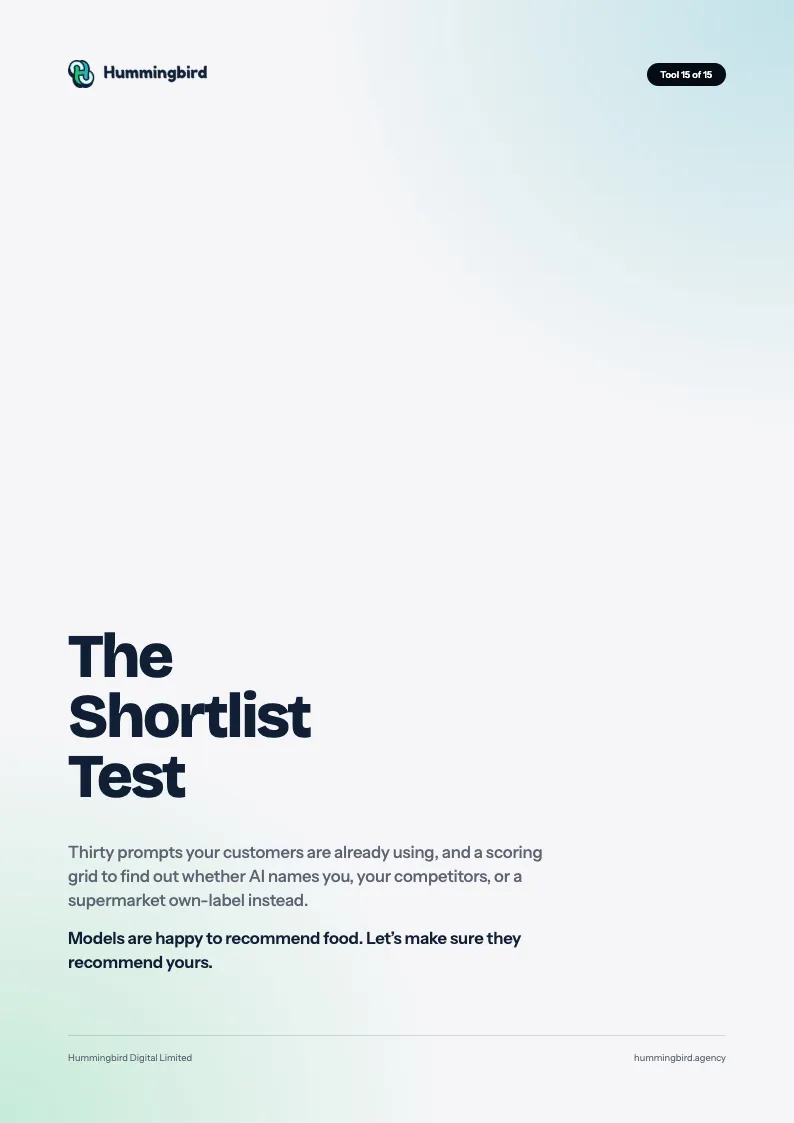
The Shortlist Test
A free 9-page worksheet and guide. Thirty prompts your customers are already using, and a scoring grid to find out whether AI names you, your competitors, or a supermarket own-label instead.
- 30 food and drink recommendation prompts across category, dietary, local, gifting and pairing
- A scoring grid for logging mention rate and description across four models
- The seven source types models draw on most for food recommendations, ranked by influence
- A gift guide and roundup pitching calendar with realistic editorial lead times
- An awards and accreditation documentation checklist
How a food and drink GEO engagement runs
Baseline the shortlists
Weeks one to two. Prompt set run across every model. You see which brands and venues AI recommends in your category, and how it describes them. Usually a short and surprising list.
Fix and document
Weeks two to five. Listings corrected, awards and accreditations documented and made retrievable, dietary positioning aligned everywhere, crawler access sorted.
Earn the mentions
Month two onwards. Roundup and gift guide inclusion worked to editorial lead times, review depth built deliberately, comparison coverage pursued.
Season and sustain
Ongoing. Monthly prompt re-runs, seasonal gift guide pitching ahead of deadlines, and correction of stale third-party information as it appears.
Food and drink brands with something specific to be known for
Models recommend against a need. The best chocolate is a hard prompt to win. The best dairy-free chocolate that does not taste like a compromise is winnable, and it is what people actually ask. If you have a genuine specialism, an award, or a dietary position you can defend, you have what this work needs.
It builds on our food and beverage SEO, food AEO, hospitality and e-commerce work:
- Award-winning producers who have never fully exploited the award
- Free-from and dietary specialists sitting on some of the most winnable prompts in food
- DTC food and drink brands competing against supermarket own label
- Drinks brands, breweries and distilleries with distinctive products and taprooms
- Restaurants, cafes and hospitality groups where local recommendation prompts are enormous
- Gifting and hamper brands with a seasonal editorial opportunity every single year

Three rules for getting named in food and drink
Own a need, not a category
Best cheese is unwinnable. Best vegan cheese that melts properly on a pizza is winnable and is what people actually type. Pick the specific need you can defend and describe it identically everywhere.
Bank your awards properly
An award is structured, dated, independent third-party proof, which is exactly what a model wants. Document every one on a retrievable page, reference it consistently, and keep it visible long after the year it was won.
Mine your reviews for language
Models absorb the words reviewers use. If customers keep describing you as generous portions or dog friendly or a good place to take fussy eaters, those phrases become the prompts you get named for. Encourage the specifics.
Food, drink and hospitality clients, and a working knowledge of the ecosystem
GEO in food depends on knowing which publications, guides, awards and communities actually carry weight, which is sector knowledge rather than software. Hummingbird works with food, drink and hospitality brands from independent producers like Rachael's Kitchen and Bear's Brownies through to hotel restaurants via our hotels and restaurants practice.
Don't just take our word for it.
“Hummingbird have built our Social presence from the ground up. Led by Tom Anderson, the team have proven to be creative, supportive and consistently great value - everything we hope for in a key business partner. We highly recommend them.”
“Hummingbird are a great digital implementation agency. I’ve worked with them for a year & am highly impressed with their proficiency in managing our social media platforms. They are enthusiastic, knowledgeable, organised, creative and has developed great insight into our business, so much so that they feel like a part of our in-house team.”
“We used Hummingbird to increase awareness of our new weekend overnight stay package and the results were fantastic. We saw huge impressions and engagement and a wonderful click through rate. I would recommend and will use again.”
Find out if AI puts you on the shortlist
Tell us what you make or where you are. We will run the recommendation prompts across the major models and send you the unedited answers, including who gets named instead of you.

Related services and reading
- AEO for Food & BeverageWin the recipe, substitution and allergen answers AI now handles directly.
- SEO for Food & BeverageRecipe, product and local search: the organic foundation.
- GEO ServicesOur core generative engine optimisation offer across all sectors.
- Hotels & RestaurantsHospitality marketing for venues, groups and restaurants.
- E-Commerce MarketingConversion, retention and lifetime value for online food and drink stores.
Frequently asked questions
Why is food and drink easier than other categories for GEO?
Because the risk of a wrong recommendation is low. Models apply their heaviest guardrails to health, finance and safety topics. Food and drink sits at the permissive end, so models name specific products, brands and venues freely.
Combine that with the fact that very few food brands are working on it deliberately, and you have an unusually open opportunity.
How much do reviews matter?
A great deal, and not only the rating. Models absorb the language reviewers use, which means the specific phrases customers repeat become the prompts you get associated with. Volume and recency matter too, particularly for venues, where a thin or stale review base is often the whole reason a restaurant is never named.
Do awards actually help AI visibility?
More than most brands realise. Awards are independent, dated, structured and easy for a model to treat as evidence of quality. The mistake is treating an award as a packaging asset and nothing else. It should have its own retrievable page, be referenced consistently across your site and listings, and stay visible in later years.
We are a restaurant, not a product brand. Does this work?
Venues are among the strongest use cases. Where to eat prompts are enormous, and models answer them with names drawn from reviews, local guides and listings. Complete accurate listings, deliberate review depth and consistent descriptions of cuisine, price band and occasion fit will usually move the needle quickly.
How do we get into gift guides and roundups?
By working to editorial lead times, which are much earlier than people expect. Christmas gift guides are largely assembled from late summer. Getting into them requires samples, a clear angle, accurate press information and pitching to a calendar rather than reacting to the season.
It is also one of the highest-value GEO activities in food, because gift guides get retrieved for years afterwards.
How long does food GEO take?
Listing and documentation fixes can register within a few weeks. Review depth and roundup inclusion build over three to four months, with a strong seasonal component because so much food editorial is calendar-driven. Faster than supplements or wellness, comparable to travel.
Can we compete with supermarket own label in AI recommendations?
Often yes, and better than in conventional search. Models asked for the best of something tend to favour specificity, provenance, awards and independent reviews, none of which own label competes on strongly. Best value is a harder prompt to win. Best quality and best for a specific dietary need are very winnable.
Should we do AEO as well?
In food they pair unusually well. Food and drink AEO gets you cited as the source on substitution, technique and allergen questions, which builds the credibility that makes a model comfortable naming you when someone asks for a recommendation. Most food clients run both.
Get in touch
Find us here
Allia Future Business Centre
Peterborough, PE2 8AN
Call or email
Opening hours
Monday - Friday
9:00 - 17:00