
In wellness, Google does not just ask whether your content is good. It asks whether you can be trusted to say it at all. We build the credibility that unlocks the rankings.

Why is SEO harder for health and wellness brands?
Health content sits in what Google calls Your Money or Your Life territory, where inaccurate information could harm someone. Google applies a higher quality bar, weighting demonstrable expertise, author credentials, accurate sourcing and site trustworthiness far more heavily than in other categories. Good content is not enough on its own: you have to be provably qualified to publish it.

Google is not judging your copy. It is judging your credibility.
Every wellness brand we audit has the same story. We publish loads of content, it is well written, and it does not rank. Meanwhile a competitor with worse design and clumsier copy sits at the top of the page.
The difference is almost never the writing. It is that the competitor's content has a named author with real qualifications, cites primary research rather than other blogs, links to an about page that establishes who they are, and sits on a domain that respectable health publications reference. Google can verify all of that. It cannot verify an anonymous 1,200-word article about sleep hygiene, so in a category where being wrong causes harm, it does not take the risk.
This is the Your Money or Your Life standard, and it is the single most misunderstood thing in wellness SEO. It means the highest-leverage work is often not on the page at all. It is naming your practitioners, documenting their credentials, getting your clinic or brand recognised as an entity, and replacing secondary sources with primary ones.
In wellness, credibility is the ranking factor. Everything else, and there is plenty of everything else, is downstream of it.
The second complication is compliance. Wellness spans regulated and unregulated territory, and the line moves depending on what you sell and how you describe it. Say the wrong thing about a treatment and you are not just risking rankings, you are risking an ASA ruling. We write to rank and to survive scrutiny, which is a narrower path than most content agencies work in.

The wellness search problems we see most
Anonymous content in a YMYL category
Articles with no author, no credentials and no review process, competing against content signed by clinicians. We build the author and reviewer infrastructure Google needs to see, including Person schema and real bios.
Health claims that cannot be supported
Copy written by a marketer that would not survive a regulator reading it. We rewrite to keep the persuasion and lose the liability, without turning your site into a legal disclaimer.
Blog volume with no cluster structure
Two hundred posts, no topical authority, several competing for the same query. We consolidate, prune, redirect and rebuild into clusters that actually establish subject-matter ownership.
Treatment and service pages that do not convert
Pages describing what a treatment is rather than answering what a patient is anxious about. We rewrite around real questions: does it hurt, how long, what does it cost, is it right for me.
Missing local and entity signals
Clinics and studios invisible in local search because their Google Business Profile, NAP consistency, location pages and practitioner entities were never built properly.
Thin sourcing
Content citing other blogs, or nothing at all. We restructure sourcing around primary research, NHS guidance, systematic reviews and named institutional sources.
What we do for health and wellness brands
E-E-A-T credibility build
Author profiles, reviewer workflows, credential documentation, Person and Organisation schema, and an about page that actually establishes trust. The foundation everything else in wellness SEO sits on.
YMYL-safe content production
Content briefed, written and reviewed against both search intent and compliance constraints, with primary sourcing built in rather than retrofitted.
Topical authority architecture
Cluster mapping so you own conditions, treatments or wellness topics comprehensively instead of holding one page in twenty different subjects.
Technical and Core Web Vitals
Crawl, index and speed work on the image-heavy, booking-integrated builds most wellness sites run on. Plus accessibility, which matters more than usual with this audience.
Local and multi-location SEO
For clinics, spas, studios and practices: Google Business Profile optimisation, genuinely distinct location pages, review strategy and local entity signals.
Compliance-Aware copy review
A second pass on high-risk pages against ASA CAP Code expectations and, where relevant, MHRA territory. We flag what needs qualifying and suggest wording that keeps the point intact.
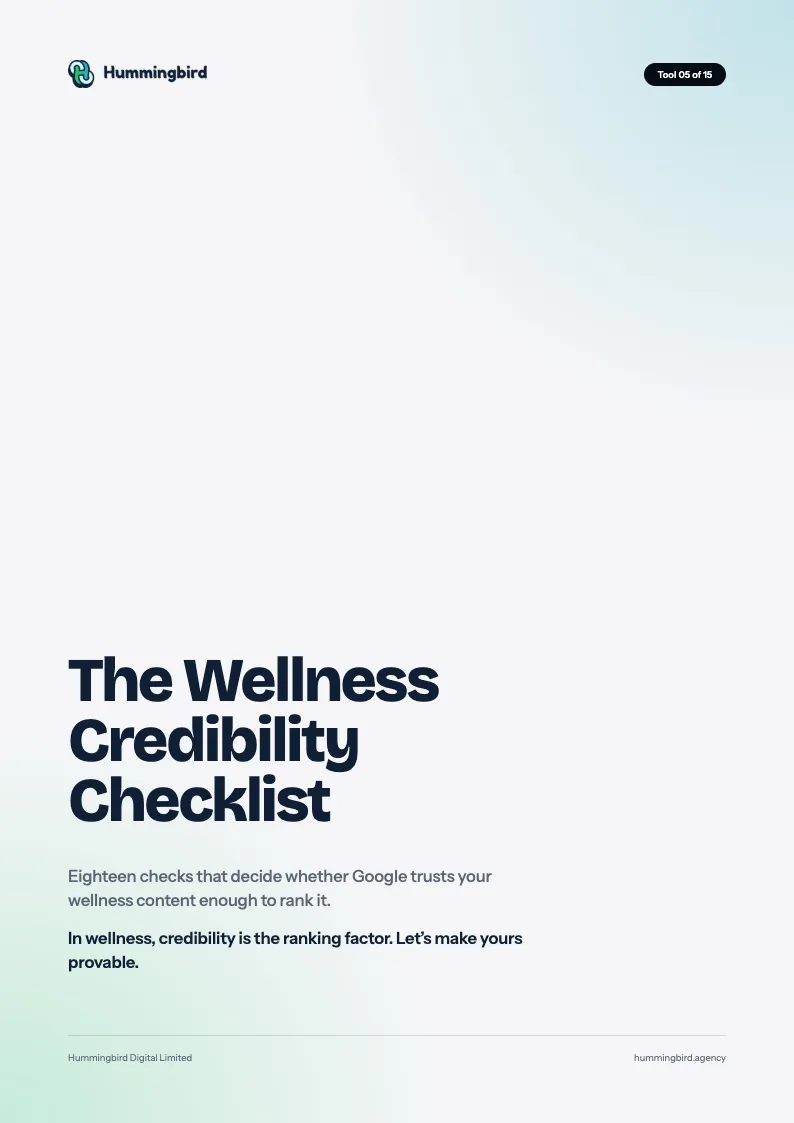
The Wellness Credibility Checklist
A free 7-page checklist. Eighteen checks that decide whether Google trusts your wellness content enough to rank it. Most brands fail the first six, and all six are fixable in a fortnight.
- 18 E-E-A-T checks grouped into authorship, sourcing, organisational trust and entity signals
- The exact author bio and reviewed-by format we implement on client sites
- A sourcing hierarchy showing which citations carry weight and which actively hurt you
- Ten copy phrases that raise compliance risk in wellness content, and safer alternatives
The six E-E-A-T signals we build first
This is the order we work in, because the first three are cheap and transformative and the last three take longer. Most wellness sites are missing all six.
| Signal | What it looks like in practice | Effort |
|---|---|---|
| Named authorship | Every health article signed by a real person, with a bio page, credentials, and Person schema linking to verifiable profiles. | Low |
| Expert review | A visible reviewed by line from a qualified practitioner, with a documented review date and process. | Low |
| Primary sourcing | Citations to research, NHS or NICE guidance and institutional sources, not to other content marketing blogs. | Low to medium |
| Organisational trust | Clear about, contact, credentials, regulatory registrations, complaints and editorial policy pages. | Medium |
| Entity recognition | Your brand and practitioners recognised as entities across the web, with consistent naming and sameAs signals. | Medium to high |
| Third-party authority | Coverage and citation from health media, professional bodies and respected publications. | High, and worth it |
How a wellness SEO engagement runs
Credibility and technical audit
Weeks one to three. We grade your E-E-A-T signals template by template, crawl the site, and flag any content carrying compliance risk. You get a scored list, not a lecture.
Build the trust layer
Weeks two to six. Authors named, reviewers assigned, schema implemented, trust pages written, sourcing corrected on your highest-traffic pages. Fast, cheap, and usually the biggest single lift available.
Consolidate and cluster
Month two onwards. Thin and competing content pruned or merged, cluster architecture built, treatment and service pages rewritten around patient questions.
Authority and expansion
Ongoing. Digital PR into health and lifestyle media, practitioner visibility building, and continuous content production against the cluster map.
Wellness brands we build search programmes for
Wellness is one of Hummingbird's core industries, and our health and wellness marketing work spans product brands, service businesses and physical venues. The SEO approach shifts significantly between them.
- Clinics, practices and private healthcare providers competing in local and condition-led search
- Spas, retreats and wellness venues where the search journey looks more like travel than healthcare
- Fitness, movement and studio brands with membership and class-booking models
- Mental health, sleep and cognitive wellness brands operating under high scrutiny
- Beauty and skincare brands where efficacy claims meet YMYL sensitivity
- Wellness apps and subscription services fighting for informational search visibility
Health and wellness is one of the industries we specialise in
Wellness sits alongside travel and hospitality as a core Hummingbird sector, which means we have worked through the compliance conversations, the practitioner sign-off processes and the E-E-A-T rebuilds before. As we note on our health and wellness page, this category needs a delicate balance of factual information and emotional appeal, and getting that balance wrong costs you either rankings or credibility.
Don't just take our word for it.
“Hummingbird have built our Social presence from the ground up. Led by Tom Anderson, the team have proven to be creative, supportive and consistently great value - everything we hope for in a key business partner. We highly recommend them.”
“Hummingbird are a great digital implementation agency. I’ve worked with them for a year & am highly impressed with their proficiency in managing our social media platforms. They are enthusiastic, knowledgeable, organised, creative and has developed great insight into our business, so much so that they feel like a part of our in-house team.”
“We used Hummingbird to increase awareness of our new weekend overnight stay package and the results were fantastic. We saw huge impressions and engagement and a wonderful click through rate. I would recommend and will use again.”
Let's find out whether Google trusts your wellness content
Send us three health pages you think should rank and do not. We will tell you which credibility signal is missing, and what it would take to fix it.

Related services and reading
- AEO for Health & WellnessGet quoted in AI answers in the category where engines are most cautious.
- GEO for Health & WellnessBe the wellness brand models are willing to name and recommend.
- SEO for SupplementsThe compliance-heavy sibling category, with its own rules and opportunities.
- SEO ServicesThe core SEO offer: technical, content, authority and reporting.
- Wellness MarketingOur full health and wellness offer across strategy, content and performance.
- Digital StrategyPositioning and messaging frameworks for a category built on trust.
Frequently asked questions
What is YMYL and does it apply to my wellness brand?
Your Money or Your Life is Google's term for topics where poor information could damage someone's health, finances or safety. Health, medical, nutrition and mental wellbeing content all sit inside it. Google's quality raters apply a higher standard to these pages, and that standard is reflected in the algorithm.
If your content could influence a health decision, YMYL applies to you, even if you are a lifestyle brand rather than a clinic.
Do I really need a named author on every health article?
For health content, yes, and it is the highest return change most wellness sites can make. Anonymous YMYL content is at a structural disadvantage. If you do not have in-house clinical expertise, the workable route is a named writer plus a credentialed reviewer, with the review documented on the page. That is a legitimate, widely accepted model.
Can you write content that ranks without making claims we cannot support?
Yes, and it is most of the craft in this sector. You do not need to claim a product cures anything in order to rank for the query. You need to answer the question the searcher actually asked, accurately and usefully, with appropriate qualification. Search rewards the genuinely useful answer, and the genuinely useful answer is usually also the compliant one.
We flag risky copy and propose alternatives rather than simply deleting your propositions.
Are you able to advise on ASA compliance?
We can flag likely issues against the CAP Code and recommend safer wording based on published ASA rulings and guidance, and we do this routinely. We are a marketing agency, not a regulatory consultancy, so for anything borderline, medical devices, or MHRA-adjacent claims, we will tell you to get legal or regulatory sign-off. We would rather be the agency that raises the flag than the one that gets you a ruling.
How long does wellness SEO take?
The credibility work shows up fast, often within four to eight weeks, because you are removing a handicap rather than building something new. Topical authority in a competitive health subject takes longer, typically six to twelve months. It is a slower category than most and a more defensible one once you are established.
We are a clinic with several locations. How does that change things?
Local becomes central. Each location needs a genuinely distinct page with its own practitioners, services, reviews and local context, not a template with the town name swapped. Google Business Profile management, review velocity and NAP consistency across directories all matter more than they would for a national product brand.
Does AI search change wellness SEO?
Significantly, and in a way that rewards the same work. AI answers are more cautious in health topics and lean harder on sources they can verify, so the E-E-A-T investment pays twice. See our wellness AEO and wellness GEO pages for how we approach the answer and recommendation layers.
Should we prune old blog content?
Often yes. Thin, outdated or unsourced health content is a liability in a YMYL category, and pruning or consolidating it frequently lifts the pages you keep. We audit before cutting, redirect properly rather than deleting, and prioritise merging over binning where there is anything worth saving.
Get in touch
Find us here
Allia Future Business Centre
Peterborough, PE2 8AN
Call or email
Opening hours
Monday - Friday
9:00 - 17:00