
You are selling in a category where the thing that would rank best is the thing you are not allowed to say. We know exactly where that line sits, and how to win without crossing it.
What makes SEO for supplement brands difficult?
Supplement brands compete for high-intent health queries while being restricted in what they can legally claim. In the UK, nutrition and health claims must be authorised on the GB register, and claims to prevent, treat or cure disease are prohibited outright. The winning approach is to answer the searcher's real question accurately and to build authority, rather than to make claims that invite an ASA ruling.

The highest-converting sentence on your site is probably the one you cannot publish
Every supplement founder we meet has had the same frustrating conversation. Customers tell them the product changed their sleep, their joints, their energy. The reviews say it. The founder believes it. And none of it can go on the website, because in the UK, nutrition and health claims about food supplements have to be authorised on the GB Nutrition and Health Claims Register, and claiming a product prevents, treats or cures a disease is not permitted at all.
So most brands do one of two things, and both lose. They either write cautious, generic copy that ranks for nothing and persuades nobody, or they write what they actually believe and eventually get an ASA ruling, a delisting, or a Google update that treats their site as low-quality health content.
There is a third route and it is genuinely better than either. You do not need to make a claim to rank for the query. Someone searching magnesium glycinate vs citrate wants an accurate comparison, not a promise. Someone searching best time to take vitamin D wants pharmacology, not marketing. Someone searching third-party tested creatine wants transparency. All of those queries have high commercial intent, all of them can be answered compliantly, and almost nobody in the category answers them properly.
That is the opportunity. The compliance constraint that frustrates you is the same constraint that has left the most valuable search territory in your category underserved, because your competitors are all busy either hedging or overreaching.
The other half of the job is authority. Supplements sit in YMYL territory, which means Google is sceptical by default. Winning here requires the credibility infrastructure covered on our health and wellness SEO page, plus a level of transparency about testing, sourcing and dosing that most brands have never documented.

The supplement search problems we see most
Copy that will not survive a complaint
Product pages, emails and blogs making unauthorised health claims. We audit against the CAP Code and the GB claims register, flag the exposure, and rewrite to keep the persuasive intent within what is permitted.
Product pages with nothing to index
Three bullet points, a dosage and a lifestyle image. We rebuild them with form, bioavailability, dosing, sourcing, testing and comparison detail, which is what both searchers and search engines need.
Invisible on comparison queries
No presence on the vs, best form of and how much should I take searches where purchase decisions are actually made. These are winnable and almost always unclaimed.
Retailers and affiliates outranking you
Amazon, Holland and Barrett and review sites ranking above you for your own products and category terms. We defend brand and product search and build the content that beats affiliate roundups on substance.
No E-E-A-T in a YMYL category
Anonymous nutrition content with no expert review or primary sourcing, competing against dietitian-authored articles. We build the author, reviewer and citation infrastructure Google looks for.
Duplicate and variant chaos
Flavours, sizes and bundles generating dozens of near-identical indexed URLs that cannibalise each other. We fix canonicalisation, variant handling and internal linking so one strong page ranks instead of six weak ones.
What we do for supplement and nutrition brands
Claims and compliance content audit
A page-by-page review of your live copy against CAP Code section 15 expectations and authorised claim wording, with risk rated and replacement wording proposed. Not legal advice, but the flags a good agency should raise.
Compliant content strategy
Cluster maps built entirely around queries you can answer accurately and completely: forms, dosing, timing, interactions, comparisons, sourcing and testing.
Product and category page SEO
Structured, detailed PDPs with Product, Offer and Review schema, variant handling done properly, and category pages built to rank rather than just to filter.
E-E-A-T and expert review
Named nutritionist or dietitian review workflows, Person schema, primary sourcing from research and official guidance, and trust pages that stand up to scrutiny.
Transparency assets
Third-party testing, certificates of analysis, sourcing and manufacturing pages. These convert sceptical buyers and give both search engines and AI answers something concrete to trust.
Digital PR and authority
Earned coverage in health, fitness and nutrition media, plus expert commentary placement. The category is sceptical, so external validation is the ceiling on everything else.
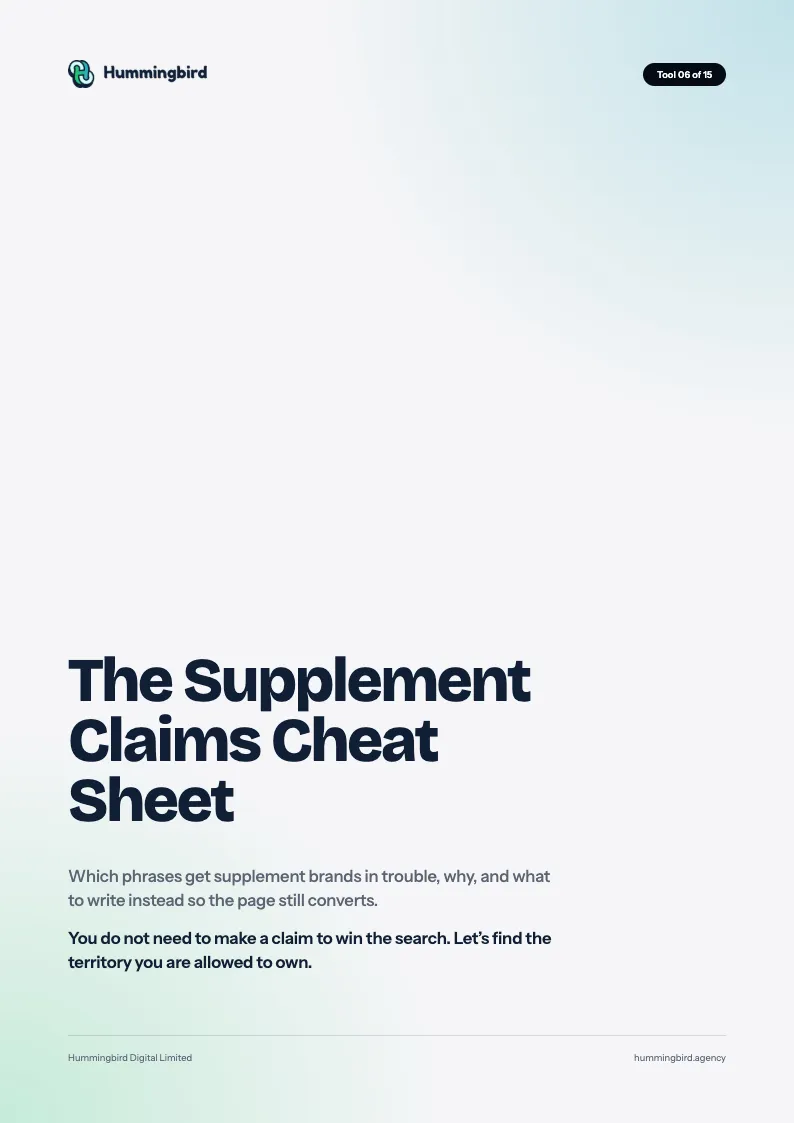
The Supplement Claims Cheat Sheet
A free 6-page cheat sheet. The reference table we give our own writers: which phrases get supplement brands in trouble, why, and what to write instead so the page still converts.
- 25 common supplement copy phrases rated red, amber or green, with the reason for each
- A rewrite column giving compliant alternatives that keep the persuasive intent
- How to use the GB Nutrition and Health Claims Register without reading it cover to cover
- A pre-publish checklist for product pages, blogs and email copy
What you can say, what you cannot, and what to write instead
A simplified working guide to how we approach supplement copy in the UK. This is how we brief writers, not legal advice, and anything borderline should go to a regulatory specialist before it goes live.
| Do not publish | Why | What we write instead |
|---|---|---|
| Supports joint health and reduces inflammation | Reducing inflammation reads as a medicinal or disease-risk claim and is not an authorised wording. | The authorised claim for the relevant nutrient, stated in permitted wording, plus accurate detail on form and dosage. |
| Boosts your immune system | Boosts is not an authorised formulation, even where a nutrient has an authorised immune-function claim. | The authorised contributes to the normal function of the immune system wording, tied to a nutrient that actually holds it and meets the significant amount threshold. |
| Helps with anxiety and low mood | This is a claim to treat a medical condition and sits in MHRA territory, not food supplement territory. | Compliant content about the nutrient's authorised role, plus genuinely useful educational content that answers the search without claiming treatment. |
| Our customers say it cured their fatigue | Testimonials cannot be used to make a claim you could not make yourself. | Reviews focused on experience of the product, taste, format and service, with claims kept out of the quoted copy. |
| General wellness claims with no specifics | General health claims must be accompanied by a specific authorised claim to be permitted. | Pair the general statement with a specific authorised claim for a nutrient present in a significant amount. |
| Botanical benefit claims | Many botanical claims remain unauthorised and on hold, so publishing them carries real risk. | Factual, non-claim content about traditional use framing where permitted, plus authority-building content that does not depend on the claim. |
How a supplement SEO engagement runs
Risk and opportunity audit
Weeks one to three. Two parallel audits: where your current copy is exposed, and where the compliant, high-intent search territory in your category is sitting unclaimed.
De-Risk and rebuild
Weeks two to six. Highest-risk pages rewritten, product pages restructured, variant and canonical issues fixed, expert review workflow established.
Own the answerable queries
Month two onwards. Content built across forms, dosing, timing, comparison and testing clusters, each page reviewed by a named expert and sourced from primary research.
Build external credibility
Ongoing. Digital PR, expert commentary, testing transparency and review depth, so both Google and AI answers have third-party reasons to trust you.
Supplement brands we build search programmes for
Supplements sit at the intersection of two Hummingbird specialisms: health and wellness and e-commerce. That combination is exactly what this category needs, because the compliance thinking and the conversion thinking have to happen in the same room.
- Vitamin, mineral and multivitamin brands competing against retailers and marketplaces
- Sports nutrition and protein brands with heavy comparison and dosing search demand
- Functional and adaptogenic brands operating in unauthorised-claim territory
- Gut health, probiotic and microbiome brands in a highly educational search category
- Beauty-from-within and collagen brands bridging wellness and skincare search
- Practitioner and clinical supplement ranges selling to both professionals and consumers

Compliance-aware, conversion-focused, and honest about the limits
We will flag risk, explain the reasoning and propose wording that keeps your proposition intact. What we will not do is tell you we can guarantee a claim is compliant, because that call belongs with a regulatory or legal specialist and any agency pretending otherwise is exposing you.
Hummingbird has spent over 20 years working with consumer and e-commerce brands, and our reputation rests on retention rather than on promises we cannot keep.
Don't just take our word for it.
“Hummingbird have built our Social presence from the ground up. Led by Tom Anderson, the team have proven to be creative, supportive and consistently great value - everything we hope for in a key business partner. We highly recommend them.”
“Hummingbird are a great digital implementation agency. I’ve worked with them for a year & am highly impressed with their proficiency in managing our social media platforms. They are enthusiastic, knowledgeable, organised, creative and has developed great insight into our business, so much so that they feel like a part of our in-house team.”
“We used Hummingbird to increase awareness of our new weekend overnight stay package and the results were fantastic. We saw huge impressions and engagement and a wonderful click through rate. I would recommend and will use again.”
Let's find the search territory you are allowed to own
Send us your product range. We will come back with the compliant, high-intent queries nobody in your category is answering properly, and flag anything on your site we would rewrite first.

Related services and reading
- AEO for SupplementsGet cited in AI answers in the most cautiously handled category in search.
- GEO for SupplementsBuild the third-party proof that makes models willing to name you.
- SEO for Health & WellnessThe E-E-A-T and YMYL foundations supplement SEO depends on.
- SEO ServicesThe core SEO offer: technical, content, authority and reporting.
- E-Commerce MarketingConversion, retention and lifetime value for online stores.
- Performance MarketingPaid media that works alongside organic in a restricted-claims category.
Frequently asked questions
Can supplement brands rank without making health claims?
Yes, and the brands doing best in this category are largely the ones that stopped trying. Comparison, dosing, timing, form, bioavailability, interaction and testing queries all carry strong commercial intent and can be answered fully within the rules.
The searcher asking magnesium for sleep which form is not waiting for you to claim a cure. They are waiting for a clear, accurate, well-sourced answer, and whoever gives it earns the sale.
What are the actual rules on supplement health claims in the UK?
In broad terms: nutrition and health claims for foods and food supplements must be authorised, with the permitted wording held on the GB Nutrition and Health Claims Register. Claims that a food can prevent, treat or cure human disease are not permitted. General health claims must be accompanied by a specific authorised claim. Many botanical claims remain on hold and unauthorised. Advertising is policed by the ASA under the CAP Code, with section 15 covering food and supplements specifically.
That is the working summary we brief against. For anything borderline, get regulatory sign-off.
Do you provide legal or regulatory advice?
No, and you should be suspicious of any agency that says it does. We work to published ASA guidance and rulings, we flag risk clearly, and we propose alternative wording. Final sign-off on anything contentious belongs with your legal or regulatory adviser. Our job is to make sure nothing reaches them as a surprise.
How do we compete with Amazon and Holland and Barrett?
Not on category head terms, where retailer authority is close to unassailable. You win on your own brand and product terms, on the educational and comparison queries retailers answer badly, and on transparency that a marketplace listing structurally cannot match: sourcing, testing, formulation reasoning and named expertise.
Then you make sure your product pages are the definitive source on your own products, so the retailer listing looks thin next to them.
Should we publish our certificates of analysis?
If you have them, yes. Third-party testing transparency is one of the strongest trust differentiators available in this category, it answers a question a growing share of buyers actively search for, and it gives both Google and AI answer engines something concrete and verifiable to cite. It is also the sort of thing competitors find hard to copy quickly.
How long does supplement SEO take to work?
Product page and technical fixes can move within four to eight weeks. Educational cluster content in a YMYL category typically takes four to eight months to build real topical authority, partly because credibility signals accumulate slowly. It is a patient category, and the payoff is that positions once earned are hard for a competitor to buy their way past.
What about AI search for supplements?
This is the category where AI models hedge hardest, which makes transparency and third-party validation disproportionately valuable. Models will rarely recommend a supplement brand on the brand's own word, but they will name brands that independent sources describe as tested and reputable. See our supplement AEO and supplement GEO pages.
Can you work with our existing regulatory consultant?
Happily, and it is the smoothest way to run this. We draft with compliance in mind and mark anything we consider borderline, they review, we adjust. It removes the usual bottleneck where marketing writes freely and regulatory rejects everything at the end.
Get in touch
Find us here
Allia Future Business Centre
Peterborough, PE2 8AN
Call or email
Opening hours
Monday - Friday
9:00 - 17:00