
Ask any AI which supplement brand to buy and watch it refuse to answer. Then ask it which brands are third-party tested and watch it name four. That gap is the whole strategy.
Can supplement brands get cited in AI answers?
Yes, but not for claim-based questions. Answer engines will not repeat unauthorised health claims and are cautious about naming supplement brands as remedies. They will readily cite factual, well-sourced content about forms, dosage, timing, bioavailability, interactions and third-party testing. That is where supplement brands can win citations compliantly.

The questions you want to be the answer to are the questions AI refuses to answer
Try it. Ask ChatGPT which magnesium supplement is best for anxiety and you get a careful non-answer with a recommendation to speak to a doctor. Ask which brand cures your fatigue and you get nothing useful at all. Answer engines are heavily guard-railed on supplements, for the same reason regulators are: unsupported health claims can cause harm.
Most supplement brands conclude from this that AI search is a dead end for them. They are looking at the wrong questions.
Because the moment you ask something factual, everything changes. What is the difference between magnesium glycinate and citrate. Should vitamin D be taken with food. How much creatine per day and does loading matter. Which supplement brands publish third-party testing. Does taking zinc with coffee affect absorption. These questions get answered fully, confidently, and with citations. And the brands being cited are almost never the biggest brands. They are the ones who wrote the clearest, best-sourced answer.
That is the entire opportunity, and it is enormous, because your competitors are all still trying to rank for the claim-based queries the engines have already closed off. The factual, mechanistic, comparison and transparency territory sits largely unclaimed, and it is the territory an educated supplement buyer actually searches before spending money.
There is a second reason to do this work. Being repeatedly cited as a factual source in your category builds exactly the credibility signal that makes models willing to name you later, when someone asks for a recommendation rather than an explanation. AEO is how you earn the right to be recommended. That part is covered on our supplement GEO page.

What AI will not answer, and what it answers gladly
We build supplement AEO programmes entirely in the right-hand column. The left-hand column is where most competitors are still spending their content budget.
| Blocked or heavily hedged | Why | The winnable equivalent |
|---|---|---|
| Best supplement for anxiety | A treatment question for a medical condition. Engines refuse or redirect to professional advice. | What does research say about magnesium and sleep quality, answered with primary sources and honest limits |
| Does X cure Y | A disease claim. No engine will attribute this to a commercial source. | What is the evidence base for X, what it does and does not show, clearly qualified |
| Which brand should I buy | A commercial recommendation in a health context. Heavily guard-railed. | Which supplement brands publish third-party test results, answered factually with your certificates public |
| Highest strength X available | Reads as a dosing recommendation with safety implications. | What dosages are used in research, and what the upper safe intake guidance says |
| X for weight loss | High-risk claim territory across every engine. | How X works metabolically, what the evidence shows, and where it is commonly misunderstood |
| Natural alternative to medication | Directly medical. Universally refused. | How X compares to Y in form, absorption and bioavailability, with the research cited |
What we do for supplement brands in the answer layer
Answer opportunity mapping
We test your category's question set across every major engine to find precisely where answers are given freely, where they are hedged, and where they are refused. That map decides the whole content plan.
Compliant answer-first content
Direct 40 to 60 word answers on factual supplement questions, written to be quotable and to survive a regulator reading them. Both constraints at once, which is the craft.
Expert review infrastructure
Named registered nutritionists or dietitians reviewing content, with credentials, registration numbers and Person schema. In this category, unattributed content is not citable.
Transparency assets
Third-party testing results, certificates of analysis, sourcing and manufacturing detail published as structured, retrievable pages. This is the most citable material a supplement brand owns.
Schema and extractability
FAQPage, Product, Organisation, Person and Speakable markup, validated, plus clean question-shaped headings and comparison tables built to be lifted.
Citation and risk tracking
Monthly tracking of which questions return you and who is cited instead, plus monitoring of how engines describe your brand so you can correct anything inaccurate.
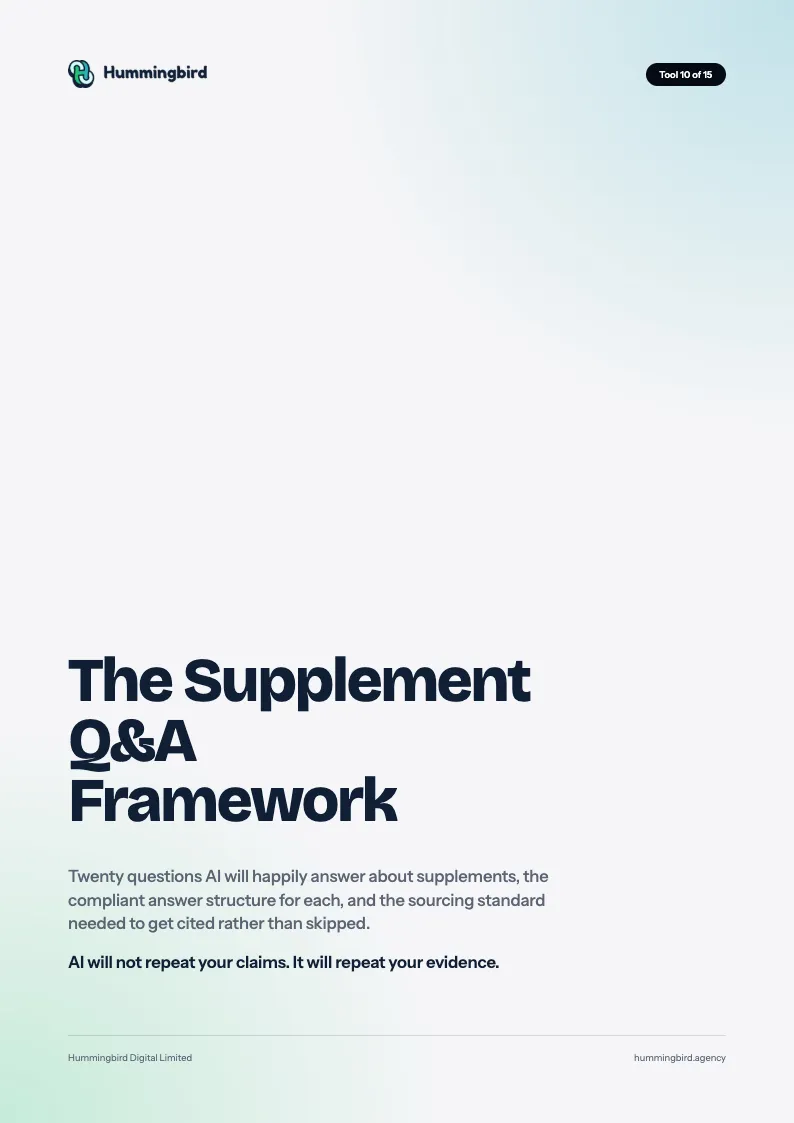
The Supplement Q&A Framework
A free 6-page template and cheat sheet. Twenty questions AI will happily answer about supplements, the compliant answer structure for each, and the sourcing standard needed to get cited rather than skipped.
- 20 high-intent supplement questions engines answer freely, grouped by form, dosing, testing, safety and research
- The compliant answer-first template we use
- A sourcing hierarchy for supplement content: what carries weight, what gets you ignored
- A pre-publish check covering both citability and CAP Code exposure
How a supplement AEO engagement runs
Map the guardrails
Weeks one to three. We test the full question set across engines and produce your opportunity map: answerable, hedged, refused. Nobody should write a word of supplement AI content before seeing this.
Build the credential layer
Weeks two to six. Expert reviewer appointed, author entities built, schema implemented, testing and sourcing pages published. The price of admission in this category.
Own the factual questions
Month two onwards. Content produced across forms, dosing, timing, interaction, bioavailability and testing clusters, each answer-first, each reviewed, each sourced from primary research.
Track and correct
Ongoing. Citation tracking, monitoring of how engines describe your brand, and correction of inaccurate third-party information that models are picking up.
Supplement brands with something real to be transparent about
This work rewards brands who have genuine substance to document: real testing, real formulation reasoning, real expertise. If you can publish a certificate of analysis and explain why you chose a particular form at a particular dose, you have everything you need and it is currently invisible.
It builds on our supplement SEO and wellness work:
- Vitamin and mineral brands where form, dose and absorption questions dominate research
- Sports nutrition brands facing constant dosing, timing and stacking questions
- Third-party tested and certified brands sitting on the most citable asset in the category
- Gut health and probiotic brands in an unusually education-led buying process
- Practitioner and clinical ranges where the audience already reads the evidence
- Functional and adaptogenic brands who need a compliant route to visibility

Three rules for compliant, citable supplement content
Answer the mechanism, not the outcome
How magnesium is absorbed is answerable, citable and compliant. What magnesium cures is neither. Mechanistic content wins citations and stays inside the rules, and educated buyers find it more persuasive anyway.
Cite upstream, always
Link to research, official guidance and authoritative registers rather than to other brands' blogs. Engines follow citation chains, and a page sourced from primary literature is dramatically more quotable than one sourced from content marketing.
Publish the awkward detail
Test results, sourcing, what your product does not do, who it is not for. Specific, verifiable, slightly inconvenient detail is exactly what a cautious engine looks for when deciding whether a commercial source can be trusted.
The two constraints, handled together
Most agencies can write for citability or write for compliance. This category demands both in the same sentence, and getting it wrong in either direction costs you: overreach and you invite a ruling, hedge and you become uncitable. We work to published ASA guidance, flag anything borderline, and send genuinely contentious wording to your regulatory adviser rather than guessing.
Over 20 years of client retention at Hummingbird is built on that kind of caution, not in spite of it.
Don't just take our word for it.
“Hummingbird have built our Social presence from the ground up. Led by Tom Anderson, the team have proven to be creative, supportive and consistently great value - everything we hope for in a key business partner. We highly recommend them.”
“Hummingbird are a great digital implementation agency. I’ve worked with them for a year & am highly impressed with their proficiency in managing our social media platforms. They are enthusiastic, knowledgeable, organised, creative and has developed great insight into our business, so much so that they feel like a part of our in-house team.”
“We used Hummingbird to increase awareness of our new weekend overnight stay package and the results were fantastic. We saw huge impressions and engagement and a wonderful click through rate. I would recommend and will use again.”
Find out which supplement questions you could own
Send us your product range. We will test your category's questions across the answer engines and show you exactly where the compliant, citable opportunities are sitting unclaimed.

Related services and reading
- SEO for SupplementsCompliant organic search: product pages, content strategy and authority.
- GEO for SupplementsBuild the third-party proof that makes models willing to name you.
- AEO for Health & WellnessThe wider YMYL answer layer that supplement content sits inside.
- AEO ServicesOur core answer engine optimisation offer across all sectors.
- E-Commerce MarketingConversion, retention and lifetime value for online supplement stores.
- AEO Guide 2026How answer engines pick sources and what to change first.
Frequently asked questions
Is there any point doing AEO if AI refuses to recommend supplements?
A great deal, because refusal only applies to a specific slice of questions. Engines decline to make treatment recommendations. They answer factual questions about forms, absorption, dosing, timing, interactions and testing constantly, and they cite sources when they do.
Those factual questions are asked by exactly the buyers worth having: the ones researching before they spend. Being the cited source there is worth more than being ignored on a query the engine has closed off anyway.
Will optimising for AI answers put us at compliance risk?
It should reduce it, if it is done properly. Citable supplement content is factual, well-sourced, appropriately qualified and expert-reviewed, which is also what compliant content looks like. The two standards point in the same direction.
The risk comes from trying to force claim-based content into an answer format. We do not do that, and we will tell you when a brief is asking for it.
Do we need a registered nutritionist or dietitian involved?
For health-adjacent content, effectively yes. Unattributed supplement content is not citable in a category engines treat as high risk. A named registered practitioner reviewing your content, with credentials and registration visible, is the single most effective unlock available.
It does not have to be a full-time hire. Most brands work with a reviewer on a retained or per-piece basis.
How do we get credit for third-party testing?
Publish it properly. Not a badge on a product page, but a structured, indexable page per batch or product with the testing body named, the parameters tested and the results visible. Then reference it consistently from product pages and content.
It is one of the few genuinely verifiable trust signals available in this category, and very few brands make it retrievable.
How long does it take to start getting cited?
Slower than travel or food, faster than you might fear. Where the credential and schema layer is in place, factual content can be cited within six to twelve weeks. Where it is not, that infrastructure comes first and adds a month or two. Categories engines treat as sensitive always take longer to enter and are harder to be displaced from once you are in.
What about our existing blog content?
Most of it will need triage rather than optimisation. Unsourced or claim-heavy supplement content is a liability in both compliance and citability terms. We audit, then merge, rewrite or prune, and redirect properly. Pruning weak health content frequently lifts the pages you keep.
Does this help our conventional SEO too?
Yes, substantially. Expert review, primary sourcing, entity signals and clear structure are all E-E-A-T signals that matter in classic rankings as well, particularly in YMYL categories. The supplement SEO page covers that side in full.
Should we do GEO as well?
It is the logical follow-on, and in this category it is where the commercial recommendations eventually get made. It is also the slowest to build, because it depends on independent third parties describing you as trustworthy. See GEO for supplements.
Get in touch
Find us here
Allia Future Business Centre
Peterborough, PE2 8AN
Call or email
Opening hours
Monday - Friday
9:00 - 17:00