
Bookings do not start on a booking page. They start eight weeks earlier with a vague idea and a search box. We make sure your brand is what comes back.
What does travel SEO involve?
Travel SEO means winning search across an unusually long consideration journey, from vague inspiration queries months out to specific availability and price checks days before booking. It combines destination and itinerary content, technical work on faceted search and booking engines, structured data for hotels and tours, and the authority needed to compete with OTAs and publishers.
Nobody books a holiday in one session
A supplement sale can happen in four minutes. A ten-day trip takes six weeks, fourteen devices, three arguments and about forty searches. Somewhere in the middle of that, your customer went from where should we go in October to is Sorrento better than Amalfi with a toddler to that specific hotel, is it worth it. Every one of those is a different search intent, and most travel brands only build content for the last one.
That is the fundamental mistake. You bid on the booking-intent terms, you write a few destination guides nobody links to, and you cede the entire inspiration and comparison layer to TripAdvisor, Booking.com, Lonely Planet and a hundred affiliate blogs who monetise your customer before you ever meet them.
The second problem is structural. Travel sites are technically hostile: faceted search that generates thousands of near-duplicate URLs, booking engines on separate subdomains, availability content that renders in JavaScript, seasonal pages that get unpublished and lose their equity every year. We have audited enough of these to know where the leaks are, and they are rarely where the client expects.
Travel SEO is won by owning the question before the booking question. Get that right and the availability searches come to you for free, because by then you are the brand they already trust.
The travel search problems we see most
OTAs outranking you for your own product
Booking.com and Expedia rank above your own hotel or tour for your own name and category. We rebuild the direct-booking case in search: better content, better schema, better internal linking, and brand terms defended properly.
Thin destination pages
Four hundred words of generic description that ranks for nothing. We replace them with genuinely useful destination content built on real query data, and structure them as hubs that pass authority to the itineraries that convert.
Faceted search chaos
Filters generating tens of thousands of crawlable near-duplicate URLs, burning crawl budget and diluting relevance. We design the canonical, parameter and robots rules that keep the useful pages and hide the rest.
Booking engine black holes
Third-party booking paths on separate subdomains that break attribution, leak equity and sometimes block indexation of key inventory. We audit the whole path and fix what can be fixed.
Seasonality treated as an afterthought
Pages built in March for a July peak that should have been live the previous November. We map content production to booking windows, not to marketing calendars.
No presence in the inspiration layer
Zero visibility on best time to visit, is it worth it, how many days, and with kids queries. That is where the shortlist gets written and where most travel brands are completely absent.
What we do for travel and tourism brands
Journey-Mapped keyword strategy
Query clusters mapped to the four stages of a travel decision: dreaming, planning, comparing, booking. Each cluster assigned to a page type, so you stop competing with yourself.
Destination and itinerary content
Guides, itineraries and comparison pages that earn links and rank, written by people who understand travel rather than by a content mill working from a keyword list.
Technical SEO for travel platforms
Faceted navigation, pagination, hreflang for multi-market sites, JavaScript rendering, Core Web Vitals on image-heavy templates, and booking engine indexation.
Travel structured data
Hotel, TouristAttraction, TouristTrip, Trip, Event, Offer, Review and FAQ schema, implemented and validated so you are eligible for the rich results travel searches generate.
Seasonal content calendar
Production scheduled against your actual booking lead times, so peak-season pages are indexed and ranking before demand arrives rather than during it.
Digital PR for travel
Earned coverage in travel media and destination publications. This is the authority layer that decides whether you can compete with OTAs at all.
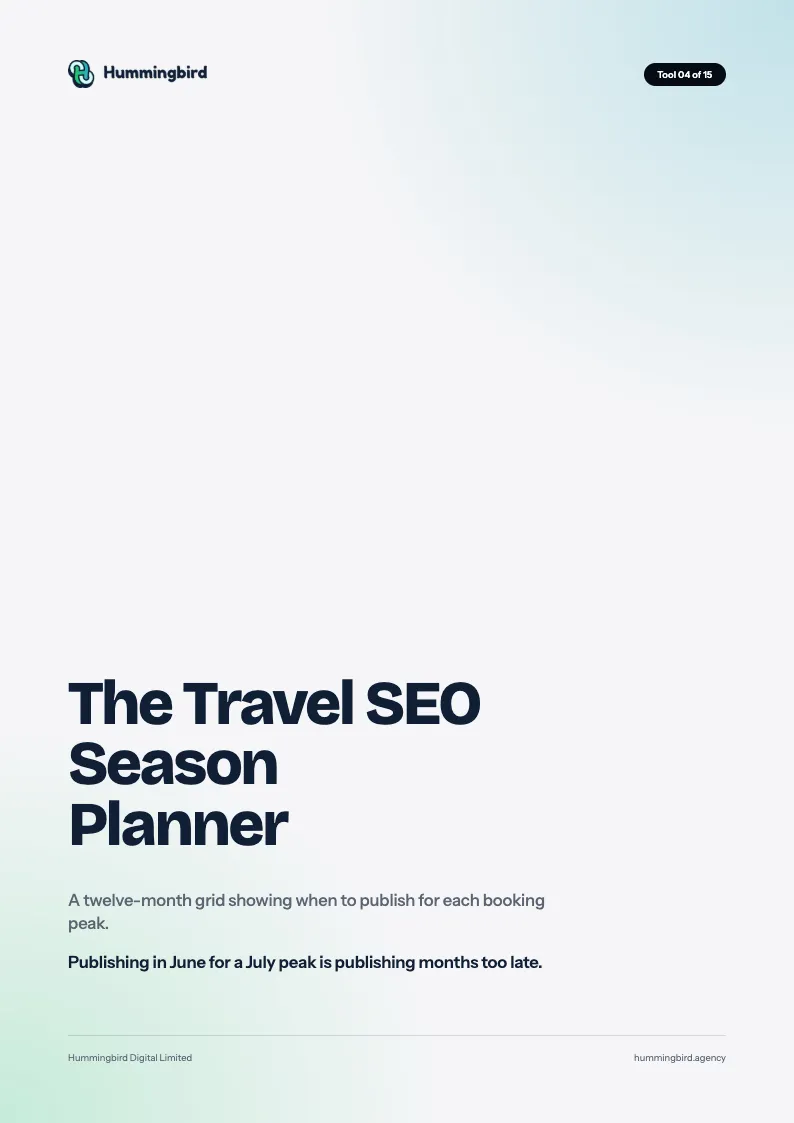
The Travel SEO Season Planner
A free 7-page cheat sheet. A twelve-month grid showing when to publish for each booking peak, because publishing in June for a July peak is publishing months too late.
- A month-by-month publishing calendar mapped to UK travel booking windows
- The 20 query types that drive inspiration-stage travel search, with the page format each one needs
- Lead-time rules of thumb for short breaks, summer sun, ski, long-haul and events
- A one-page checklist for auditing seasonal pages before you unpublish anything
The four stages of a travel search, and what each needs
This is the map we build every travel SEO programme around. Most brands are strong in stage four and invisible in stages one and two, which is the same as being invisible.
| Stage | What they search | What the page must be | Commercial job |
|---|---|---|---|
| Dreaming | where to go in November, best beaches in Europe, unusual UK weekends away | Inspirational, visual, link-worthy editorial with real recommendations | Get into the consideration set and capture the email |
| Planning | best time to visit X, how many days in X, X with kids, X vs Y | Genuinely useful comparison and practical detail, answer-first and quotable | Become the trusted source before price enters the conversation |
| Comparing | X reviews, is X worth it, cheapest way to do X, alternatives to X | Honest, specific, evidence-backed, with reviews and transparent inclusions | Win the shortlist against OTAs and affiliates |
| Booking | X availability, X prices, book X direct, discount code X | Fast, frictionless, schema-rich, with direct-booking benefits obvious | Convert, and defend the direct margin |
How a travel SEO engagement runs
Audit against the journey
Weeks one to three. Technical crawl plus a stage-by-stage visibility audit showing exactly where in the booking journey you disappear and who takes your place.
Fix and defend
Weeks two to six. Technical blockers cleared, brand and product terms defended, existing destination pages consolidated and rebuilt rather than left to compete with each other.
Build the inspiration layer
Month two onwards. The planning and comparison content you have never had, produced on a cadence tied to your booking windows and supported by digital PR.
Compound through seasons
Ongoing. Each season's pages are refreshed rather than replaced, so equity accumulates year on year instead of resetting every January.
Travel brands we build search programmes for
Hummingbird has worked in travel and leisure for years, across tour operators, rail experiences, hotels, attractions and destination organisations. It is one of the sectors that made us, which is why our travel and leisure marketing work sits at the centre of the agency rather than at the edge.
- Tour operators and specialist travel companies competing with OTAs for their own inventory
- Hotels, resorts and holiday parks fighting for direct bookings against aggregator listings
- Attractions, experiences and events with sharp seasonal demand curves
- Destination marketing organisations and tourism boards building regional visibility
- Travel e-commerce, from luggage and kit to insurance and pre-departure services
- Rail, cruise and coach operators with long consideration windows and high basket values

Travel is not a sector we have read about
We have run search and paid campaigns for rail experience operators, tour operators, hotels and destination organisations, and we understand the specific pain of a long consideration window and a short booking one. Hummingbird has been doing this for over 20 years, and travel has been part of it from the start.
As the Expedia research we cite on our travel marketing page shows, 77% of consumers use social media for travel inspiration, which is precisely why search and social have to be planned as one programme rather than two budgets.
Don't just take our word for it.
“Hummingbird have built our Social presence from the ground up. Led by Tom Anderson, the team have proven to be creative, supportive and consistently great value - everything we hope for in a key business partner. We highly recommend them.”
“Hummingbird are a great digital implementation agency. I’ve worked with them for a year & am highly impressed with their proficiency in managing our social media platforms. They are enthusiastic, knowledgeable, organised, creative and has developed great insight into our business, so much so that they feel like a part of our in-house team.”
“We used Hummingbird to increase awareness of our new weekend overnight stay package and the results were fantastic. We saw huge impressions and engagement and a wonderful click through rate. I would recommend and will use again.”
Let's see where your booking journey leaks
Send us your site and your three biggest destinations or products. We will show you which stage of the search journey you are losing, and who is taking that traffic instead.

Related services and reading
- AEO for TravelBe the answer when someone asks how many days in Lisbon or best time to visit.
- GEO for TravelGet named when a model builds someone's itinerary and shortlist.
- SEO ServicesThe core SEO offer: technical, content, authority and reporting.
- Travel MarketingOur full travel and leisure offer across strategy, content and performance.
- Tourism Marketing Agency GuideHow to choose a tourism marketing agency in 2026, and what to ask them.
- Travel Agency Digital MarketingOur guide to digital marketing for travel agencies and operators.
Frequently asked questions
How is travel SEO different from normal SEO?
The consideration window. Most sectors have a search journey measured in days. Travel is measured in weeks or months, across many devices and often more than one decision maker, which means you need content for stages that do not look commercial at all.
There are also technical differences that barely exist elsewhere: faceted availability search, third-party booking engines, multi-market hreflang, and travel-specific schema types. Generalist SEO advice tends to fall apart at exactly these points.
How do we compete with Booking.com and TripAdvisor?
Not head on, on head terms. You will not outrank an OTA for hotels in Rome and you should not spend money trying. You beat them on specificity and first-party knowledge: your property, your itineraries, your region, your expertise, and the long-tail planning questions their templated pages answer badly.
Then you defend your brand and product terms properly, because that is where OTAs quietly take margin that was already yours.
When should we publish content for peak season?
Work backwards from the booking window, not the travel date. For UK summer sun, that generally means publishing and indexing from the previous autumn. For ski, late summer. For short breaks, six to ten weeks ahead. New pages need time to earn rankings before demand peaks, and refreshing an existing page beats publishing a new one every year.
The free season planner above sets this out month by month.
Do you work with hotels as well as tour operators?
Yes, and the work differs meaningfully. Hotels lean on local and property-level SEO, Google Business Profile, room-type content and direct-booking incentives. Tour operators lean on destination and itinerary content, comparison pages and authority building. Attractions sit somewhere between, with heavy seasonality. We scope to the model rather than applying one template.
Can SEO help with off-peak and shoulder season demand?
It is one of the most underrated uses of the channel. Off-peak demand is driven by different queries entirely, things like where is warm in November and quiet UK weekends in February, and those searches are far less competitive than peak equivalents. Building content for them is usually cheaper than discounting your way to occupancy.
How does travel SEO work alongside paid search?
They should be planned together. Paid covers immediate booking intent and fills gaps while organic builds. Organic owns the inspiration and planning layers where paid is expensive and poorly targeted. Where we run both, we use search query data from paid to prioritise organic content and use organic coverage to stop paying for terms we already own.
What about AI search and travel?
Travel is the category most transformed by it. People now ask models to plan itineraries and shortlist destinations outright, which means being named in a generated answer can matter more than ranking fourth. That is a different discipline, covered on our travel AEO and travel GEO pages.
Do you handle multi-country and multi-language travel sites?
Yes. Hreflang implementation, market-level keyword research, currency and locale handling and duplicate content management across markets. It is fiddly work and it is where a lot of international travel sites quietly lose visibility in their secondary markets.
Get in touch
Find us here
Allia Future Business Centre
Peterborough, PE2 8AN
Call or email
Opening hours
Monday - Friday
9:00 - 17:00