
Someone just asked ChatGPT to plan five days in Andalusia and recommend who to book with. Four brands got named. We make sure you are one of them.

What is GEO for travel brands?
Generative engine optimisation for travel means influencing which operators, hotels and destinations AI models name when travellers ask them to plan trips or recommend who to book with. It works by building consistent, corroborated information about your brand across the review sites, editorial roundups, guides and directories that models draw on when forming recommendations.

AI did not just change travel search. It became a travel agent.
This is the part that should keep travel marketers awake. People are not asking models for facts about destinations any more. They are asking them to do the job: plan me a ten-day trip to Japan in April with two teenagers, mid-range budget, no more than three hotel changes. And the model does it, complete with a suggested itinerary, named hotels, named tour operators and a booking order.
Think about what has just happened there. A brief that would once have gone to a travel agent, or been assembled across forty searches and a dozen browser tabs, has been answered in one exchange. And a handful of brands were named inside it, with implicit endorsement, at zero cost to them.
Every brand not named was eliminated before the traveller knew they existed. There is no page two of a generated itinerary.
The mechanics of getting named are not what most travel marketers expect. Your own website is only a small part of it. A model's view of who to recommend in your category is assembled from what independent sources say: Tripadvisor and Google reviews, best-of roundups in travel media, Reddit and forum threads, specialist guidebooks and blogs, awards, association memberships and directory listings. Where those sources consistently describe you as the specialist for something specific, the model states it confidently. Where they say nothing about you, the model recommends someone it is surer about.
Which means travel GEO is closer to reputation engineering than to search marketing. The good news is that travel has the richest ecosystem of independent sources of any consumer category, so there is more to work with here than almost anywhere else.

Five travel prompt types, and what gets a brand named
These are the prompt shapes we baseline for every travel client. Each one is won differently, and the specific ones are far easier to win than the broad ones.
| Prompt type | Example | What gets you named |
|---|---|---|
| Itinerary building | plan 10 days in Vietnam for a family with young children | Being named in published itineraries and guides for that exact trip shape, plus clear positioning as a family specialist |
| Operator shortlisting | which UK operators run small group walking holidays in Italy | Directory and association listings, roundups of specialist operators, consistent niche description across sources |
| Accommodation shortlisting | best boutique hotels in the Cotswolds for a quiet weekend | Review depth and sentiment, editorial roundup inclusion, distinctive and consistently described character |
| Suitability matching | where should I go in November for guaranteed sun on a mid budget | Being cited as the authority on that destination or season, with corroborating third-party coverage |
| Comparison | is X better than Y for a first trip to Africa | Independent comparison coverage and reviews that state your specific differentiator clearly |
What we do for travel brands in the recommendation layer
Travel prompt baseline
Thirty to sixty real planning and booking prompts for your destinations and trip types, run across ChatGPT, Perplexity, Gemini, Copilot and Claude, with every named brand logged.
Consensus audit
We find what the web collectively says about you and where it contradicts itself: outdated itineraries, wrong pricing, closed properties, discontinued routes, or a specialism nobody mentions.
Niche positioning for machines
Models recommend specialists. We make sure every source describes your specialism the same way, in the same words, so the association becomes unambiguous.
Roundup and editorial inclusion
Earned placement in the best-of lists, specialist guides and travel media roundups that models retrieve from most heavily for recommendation prompts.
Review and community depth
Tripadvisor, Google and Reddit strategy. Models weight review volume, recency and sentiment heavily in travel, and most operators leave this to chance.
Entity and crawler foundations
Consistent brand entity across your site, Wikidata, Google Business Profile, associations and directories, plus deliberate LLM crawler access and llms.txt.
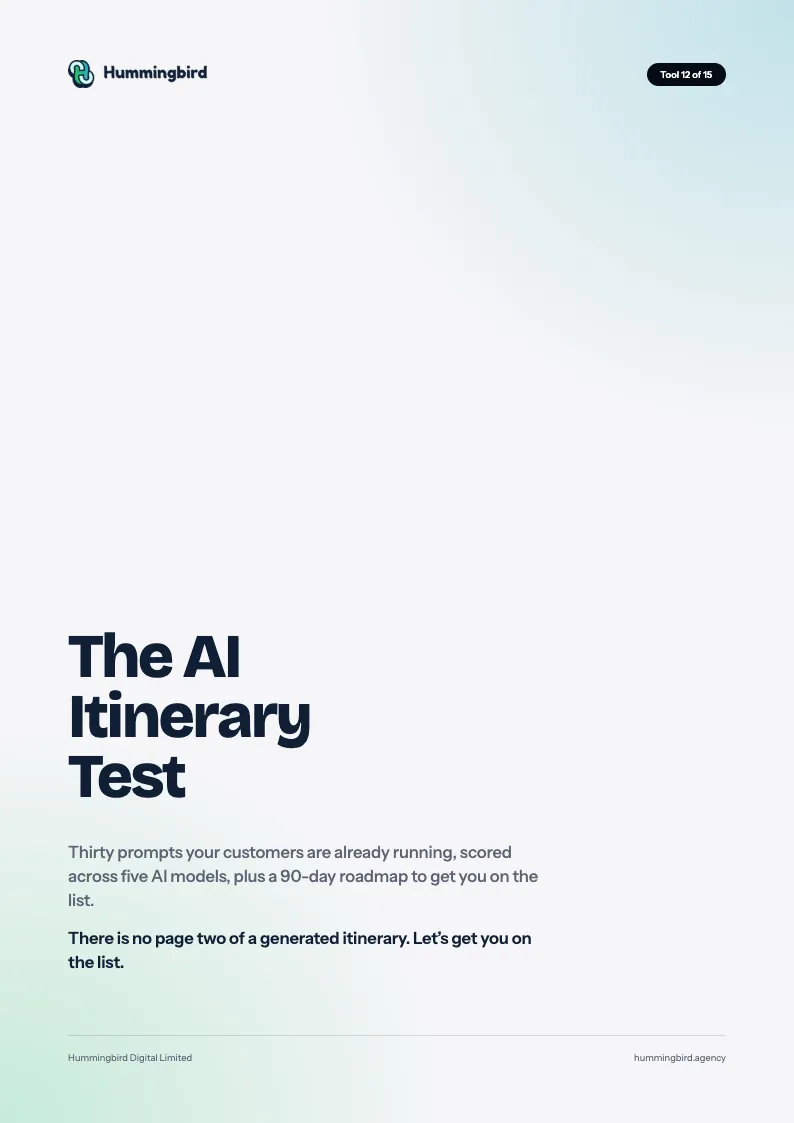
The AI Itinerary Test
A free 9-page worksheet and guide. Run the exact prompts your customers are using and find out whether AI recommends you, ignores you, or describes you wrongly. Most operators are unpleasantly surprised.
- 30 ready-to-run travel planning and shortlisting prompts across five prompt types
- A scoring grid for logging mention rate, position and how you are described, across five models
- The seven source types models lean on most for travel recommendations, ranked
- The five factual contradictions that get travel brands dropped from shortlists
- A 90-day travel GEO roadmap you can hand to your team
How a travel GEO engagement runs
Baseline the recommendations
Weeks one to three. Full prompt set run across every major model. You get a document showing precisely which operators and properties AI is currently recommending in your space, and how it describes them.
Fix the facts
Weeks two to six. Contradictions corrected, stale third-party data updated, entity signals aligned, crawler access sorted. Cheap and frequently the reason a brand is being misdescribed or skipped.
Build the consensus
Month two onwards. Roundup inclusion, editorial coverage, review depth, community presence and retrievable comparison content, all pushing the same specific positioning.
Monitor and steer
Ongoing. Monthly prompt re-runs, competitor share tracking by destination and trip type, and reallocation towards whichever sources are demonstrably moving your mention rate.
Travel brands with a genuine specialism
GEO rewards specificity brutally. If you are a generalist competing on breadth, models will default to the largest brands they know. If you are the operator who does small group cycling in the Dolomites, or the hotel that is genuinely the best option for a dog-friendly Northumberland weekend, you have something a model can attach a recommendation to.
This work builds on our travel SEO, travel AEO and wider travel marketing offer:
- Specialist tour operators with a clear, defensible niche worth being known for
- Boutique and independent hotels competing against chains and aggregator listings
- Attractions and experiences that should be named in any itinerary for their region
- Destination organisations shaping how a whole region gets recommended
- Rail, cruise and expedition operators with distinctive products models can describe
- Adventure, wellness and special interest travel where the niche is the entire proposition

Three rules for getting named in travel
Be the specialist, not an option
Models recommend the brand that is clearly the answer to a specific need over the brand that could serve many needs. Narrow your machine-readable positioning even if your business is broader than that. Breadth is invisible.
Consistency beats volume
One clear description of what you do, repeated identically across your site, directories, reviews and coverage, outperforms scattered mentions in many places. Contradiction is what makes a model hedge or skip you.
Keep the facts alive
Closed properties, retired routes, old prices and superseded itineraries still circulating on third-party sites actively damage you. Nothing gets a brand dropped from a recommendation faster than a model finding conflicting information.
Travel is a Hummingbird specialism, not a vertical we added
We have worked with tour operators, rail experience companies, hotels, attractions and destination organisations for years, which matters here because GEO in travel depends on knowing the ecosystem: which publications, associations, directories and communities actually carry weight in your niche. That is sector knowledge, not a software subscription.
We are also independent, so when the honest answer is that your fundamentals need work before GEO will pay, that is what you will hear.
Don't just take our word for it.
“Hummingbird have built our Social presence from the ground up. Led by Tom Anderson, the team have proven to be creative, supportive and consistently great value - everything we hope for in a key business partner. We highly recommend them.”
“Hummingbird are a great digital implementation agency. I’ve worked with them for a year & am highly impressed with their proficiency in managing our social media platforms. They are enthusiastic, knowledgeable, organised, creative and has developed great insight into our business, so much so that they feel like a part of our in-house team.”
“We used Hummingbird to increase awareness of our new weekend overnight stay package and the results were fantastic. We saw huge impressions and engagement and a wonderful click through rate. I would recommend and will use again.”
Find out whether AI is recommending you
Give us your brand and three competitors. We will run a travel prompt audit across the major models and send you the unedited answers your customers are getting.

Related services and reading
- AEO for TravelOwn the answer inside search for planning and destination questions.
- SEO for TravelThe foundation: models cannot recommend what they cannot retrieve.
- GEO ServicesOur core generative engine optimisation offer across all sectors.
- Travel MarketingOur full travel and leisure offer across strategy, content and performance.
- Tourism Marketing Agency GuideChoosing a tourism marketing agency in 2026, and what to ask them.
Frequently asked questions
Can you guarantee we will be recommended by ChatGPT?
No, and nobody can. Generative responses vary by user, phrasing, session context and model version, so there is no fixed position to guarantee. What we can do is measure your mention rate across a fixed prompt set over time and work to increase it, which is a real, trackable outcome.
If an agency guarantees you a position in an AI answer, that is the point to end the conversation.
Why does AI recommend competitors instead of us?
Usually one of three reasons. You are absent from the source types models retrieve for recommendation prompts, meaning roundups, directories, reviews and specialist guides. Or the information about you is inconsistent, so the model hedges and picks something safer. Or your positioning is too broad for the model to attach to a specific need.
The baseline audit tells you which of the three it is, and they have different fixes.
How is this different from travel AEO?
AEO gets your content quoted when someone asks a question inside a search engine, such as how many days in Seville. GEO gets your brand named when someone asks a model for a recommendation, such as who should I book Andalusia with. One is about your pages, the other is mostly about what other sources say about you. See travel AEO.
Do reviews really affect AI recommendations?
In travel, heavily. Review platforms are among the most retrieved sources for accommodation and operator recommendations, and models pick up on volume, recency and the specific language reviewers use. A property described repeatedly as quiet and dog friendly becomes the answer to prompts containing those words.
This means review strategy is GEO work, not just reputation management.
Should we let AI crawlers access our site?
For most travel brands, yes. Blocking GPTBot, PerplexityBot, ClaudeBot or Google-Extended reduces the chance of being retrieved and recommended, and visibility is worth more to an operator than content protection. If your published guides are genuinely a competitive asset, there is a real trade-off and we will walk you through it rather than deciding for you.
How long does travel GEO take?
Factual and access fixes can register within a few weeks, particularly in retrieval-heavy tools like Perplexity. Consensus change, which is what moves ChatGPT and Gemini, typically shows clearly at three to four months and keeps compounding. It is the slowest of the three disciplines and the hardest for a competitor to undo.
Does this work for destinations as well as businesses?
Yes, and destination organisations have an unusual amount of leverage, because they can shape the whole regional narrative that models pick up. It is also one of the clearest cases for GEO: if a model recommends your region for the wrong reasons, or omits it from itineraries entirely, that is a measurable visibility problem with an addressable cause.
What do you need from us to start?
Your top destinations or trip types, your three or four main competitors, and an honest description of what you are genuinely best at. That is enough to build the prompt set and run the baseline. Everything else comes out of what the baseline shows.
Get in touch
Find us here
Allia Future Business Centre
Peterborough, PE2 8AN
Call or email
Opening hours
Monday - Friday
9:00 - 17:00