
Your customer asked how many days they need in Seville and got a complete answer without visiting a single website. The only question that matters is whose words they read.

Why does AEO matter more in travel than in most sectors?
Travel planning is built almost entirely from questions: where to go, when to go, how long for, is it worth it, what to do with children. Answer engines handle those questions directly, which means a large share of travel research now completes before anyone reaches a website. Being the cited source in that answer is how you enter the shortlist.
Travel planning was always a series of questions. Now something else is answering them.
Think about how a trip actually gets planned. Is October a good time for Croatia. Do I need a car in Madeira. Is three nights enough for Rome. Best area to stay in Lisbon with a toddler. Cotswolds or Peak District for a walking weekend. Every one of those is a question, phrased as a question, and there are thousands of them in the run-up to a single booking.
For twenty years those questions produced a page of links and your job was to be one of them. Now they produce an answer. Google's AI Overview summarises it and cites two or three sources. A voice assistant reads out one. Someone planning in ChatGPT gets a paragraph and moves on. The research phase increasingly completes without a website visit at all.
This is either the biggest threat or the biggest opportunity in travel marketing, depending entirely on whether you are the source being quoted. Because here is the thing that should encourage you: the sources getting cited in travel answers are frequently not the OTAs. Aggregator pages are templated and vague. Answer engines prefer specific, confident, first-hand detail, which is exactly what a real operator, hotel or destination organisation has and a marketplace does not.
For once, the structural advantage is yours. Most travel brands are simply not writing in a way a machine can lift. Their destination pages open with three paragraphs of atmospheric scene-setting before answering anything, which reads beautifully to a human editor and is useless to an extraction model looking for a direct answer in the first 60 words.

What answer engines have taken over in travel search
These are the query types where the answer now happens before the click. Each one needs a different content response, and each one is winnable.
| Query type | Example | What the engine wants | Your move |
|---|---|---|---|
| Timing | best time to visit the Amalfi Coast | A direct month range, then the reasoning: weather, crowds, prices | Answer in one sentence, then a month-by-month table. Tables get lifted. |
| Duration | how many days in Kyoto | A confident number with a caveat, not a hedge | Lead with the number. Three to four days covers the essentials. Then justify it. |
| Comparison | Tenerife or Lanzarote for families | A clear differentiator per option, not a diplomatic non-answer | Take a position. Comparison tables with honest trade-offs get cited constantly. |
| Practicalities | do I need a car in Madeira | A yes or no, then the exceptions | Answer first, qualify second. This is the single most common failure in travel copy. |
| Suitability | is Dubrovnik good with toddlers | Specific, experiential detail a template page cannot fake | First-hand knowledge, named specifics, honest limitations. |
| Cost | how much is a week in Iceland | A realistic range broken down by component | Transparent, dated cost breakdowns. Update them and say when you last did. |
What we do for travel brands in the answer layer
Travel answer baseline
We run your priority destination and product questions through AI Overviews, Copilot, Perplexity and ChatGPT, and log who is cited, what is quoted and where you appear. Usually the answer is you do not.
Question mining at scale
People Also Ask harvesting across your destinations, plus forum and community mining and your own enquiry inbox, to build the real question set rather than a keyword list.
Answer-First rewrites
Existing destination, itinerary and property pages restructured so the direct answer comes first and the atmosphere follows. Same brand voice, extractable structure.
Travel schema implementation
FAQPage, TouristTrip, TouristAttraction, Hotel, Trip, Event, Offer and Speakable markup, validated. This is how engines work out what your page is about and whether to trust it.
Comparison and table assets
Month-by-month climate tables, cost breakdowns, area guides and honest X versus Y comparisons. Structured formats are disproportionately likely to be quoted.
Citation tracking
Monthly reporting on which travel questions return you, which competitors hold the ones you want, and what snippet is being pulled from your pages.
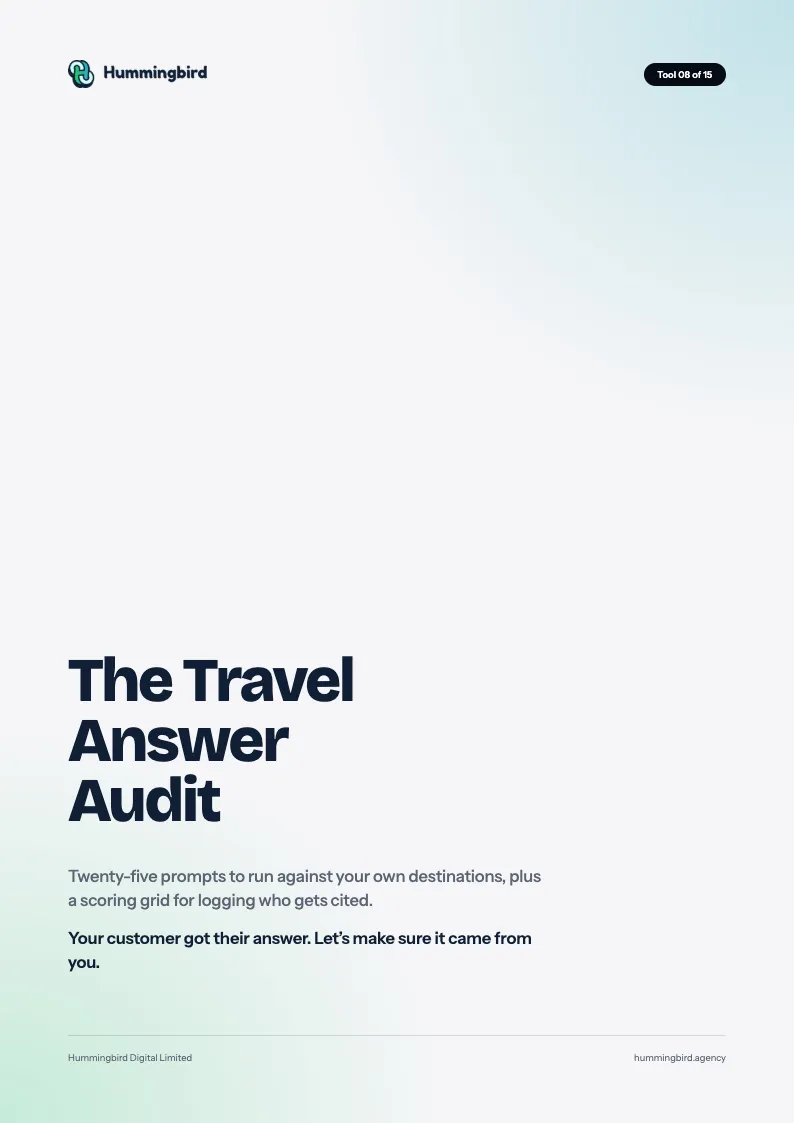
The Travel Answer Audit
A free 7-page worksheet. Twenty-five prompts to run against your own destinations, plus a scoring grid for logging who gets cited. You will know within an hour whether AI is recommending you or someone else.
- 25 ready-to-run prompts covering timing, itineraries, comparisons, practicalities and operator recommendations
- A scoring grid for logging citations across Google AI Overviews, Perplexity, ChatGPT and Copilot
- The answer-first opening template we apply to client destination pages
- A checklist of the seven travel schema types worth implementing, in priority order
How a travel AEO engagement runs
Baseline your destinations
Weeks one to two. Priority questions per destination and product run across every major answer engine, results logged verbatim. You see exactly what your customers are being told, and by whom.
Restructure what you have
Weeks two to five. Your best existing pages rewritten answer-first, schema implemented, headings rephrased as the questions people actually ask. Fastest wins in the whole programme.
Build the answer estate
Month two onwards. New question-led pages and destination FAQ hubs, plus the comparison tables and cost breakdowns that engines lift most readily.
Track through the season
Ongoing. Monthly citation tracking, seasonal question sets refreshed ahead of demand, and expansion into the next tier of destinations.
Travel brands with an unfair advantage in the answer layer
The brands that win travel AEO are the ones with genuine first-hand knowledge, because that is what answer engines cannot get from an aggregator. If your team has actually been there, run the tours, hosted the guests or knows the region, you are sitting on the raw material. It just needs restructuring.
We work across the travel and leisure sector, building on the travel marketing and travel SEO work that sits underneath it:
- Specialist tour operators whose expertise is the product and is currently invisible to machines
- Hotels and resorts whose local area knowledge could own every question about their destination
- Attractions and experiences facing practical, high-volume questions about visiting
- Destination organisations and tourism boards who should be the definitive answer for their region
- Rail, cruise and coach operators with complex practical questions to answer clearly
- Travel retailers and services where kit, insurance and preparation questions dominate search

Three rules we apply to every travel page
Answer in the first 60 words
Before the scenery, before the brand voice, before the sell. A machine reading your page should be able to lift a complete, accurate answer from the opening paragraph. The atmosphere still gets its place, just underneath.
Take a position
It depends is invisible to an answer engine. Three days is enough for Seville if you skip the day trips gets quoted. Travel brands hedge to avoid disappointing anyone and end up being cited by nobody.
Date your facts
Prices, opening times, visa rules and route information all decay. Publishing a last-verified date and keeping it current is a credibility signal for engines and a genuine service to travellers.
Travel expertise plus answer engine expertise, in one team
Hummingbird has worked in travel and leisure for years and has been publishing on answer engines since the category emerged, including our AEO guide. This page exists because the two disciplines are not separable any more: you cannot optimise travel answers without understanding how travellers actually plan.
Don't just take our word for it.
“Hummingbird have built our Social presence from the ground up. Led by Tom Anderson, the team have proven to be creative, supportive and consistently great value - everything we hope for in a key business partner. We highly recommend them.”
“Hummingbird are a great digital implementation agency. I’ve worked with them for a year & am highly impressed with their proficiency in managing our social media platforms. They are enthusiastic, knowledgeable, organised, creative and has developed great insight into our business, so much so that they feel like a part of our in-house team.”
“We used Hummingbird to increase awareness of our new weekend overnight stay package and the results were fantastic. We saw huge impressions and engagement and a wonderful click through rate. I would recommend and will use again.”
Find out what AI is telling travellers about your destination
Give us three destinations or products. We will run the real questions through the answer engines and send you the unedited results, including who is being cited instead of you.

Related services and reading
- SEO for TravelThe technical and content foundation the answer layer is built on.
- GEO for TravelGet named when a model plans someone's trip and builds their shortlist.
- AEO ServicesOur core answer engine optimisation offer across all sectors.
- Travel MarketingOur full travel and leisure offer across strategy, content and performance.
- AEO Guide 2026How answer engines pick sources and what marketing teams should change.
- Tourism Marketing Agency GuideChoosing a tourism marketing agency in 2026, and what to ask them.
Frequently asked questions
If AI answers the question, why would anyone visit our site?
Some will not, and those visits were often low-value anyway. What you gain is being the brand named at the moment the shortlist forms, which is worth considerably more than a bounce on a destination guide.
In practice, cited brands see the effect downstream: more branded search, more direct traffic, and enquiries that arrive already half-convinced. The alternative is not keeping those clicks. It is a competitor being cited while your traffic falls anyway.
Can a small operator get cited ahead of Booking.com or TripAdvisor?
Yes, and this is genuinely the most encouraging thing about the answer layer for travel. Aggregators generate destination content at scale, which makes it generic. Answer engines reward specificity, confidence and first-hand detail.
A specialist operator who can state plainly that the coastal path is closed until April, or that three nights is enough unless you want the day trip, is more citable than a templated page that hedges everything.
Which answer engines matter most for travel?
Google AI Overviews by volume, because that is where most travel research still starts. Perplexity punches above its weight with detailed planning queries and cites sources prominently. ChatGPT matters increasingly for itinerary building rather than single questions. Voice assistants matter for practical in-destination queries.
We baseline all of them and weight the work towards where your particular audience is actually planning.
Does this replace our travel SEO?
No, it sits on top of it. Answer engines draw on indexed web content, so if your pages are slow, thin or badly structured, AEO effort underperforms. The good news is the two overlap heavily: answer-first content and clean schema help conventional rankings too. See our travel SEO page for the foundation.
How do you measure success when there is no click?
Citation share across a fixed question set, snippet ownership showing which of your exact sentences get quoted, impression growth on question-shaped queries in Search Console, and downstream branded search and direct traffic. We report all four and label what is measured versus what is directional.
How quickly can we expect to see results?
Restructuring an existing page that already has authority can produce citations within four to six weeks. New question-led content in a competitive destination typically takes eight to sixteen weeks. It is materially faster than classic travel SEO, which is one reason we usually start here.
What content should we prioritise first?
Your highest-value destinations or products, and within those, the practical questions rather than the inspirational ones. Timing, duration, cost and suitability questions are asked constantly, answered badly by aggregators, and lead directly into booking intent. Inspiration content is worth doing second.
Should we also be doing GEO?
If people ask models to plan itineraries in your category, and in travel they absolutely do, then yes. AEO gets you cited inside search results. GEO for travel gets you named when someone asks ChatGPT to plan their trip outright. Most travel clients end up running both.
Get in touch
Find us here
Allia Future Business Centre
Peterborough, PE2 8AN
Call or email
Opening hours
Monday - Friday
9:00 - 17:00